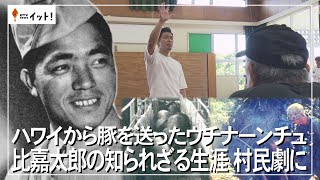
NAHA, Nov 29 (News On Japan) - A new local production in Kitanakagusuku Village is shining a light on the little-known life of Taro Higa, the Nisei from Hawaii who led efforts after the war to send pigs to Okinawa, even as his contributions have long remained overshadowed and largely forgotten.
The village drama, which will be performed over two days starting tomorrow, centers on Higa, who was born in Hawaii in 1916 and spent his childhood in Kitanakagusuku, where his grandparents lived. During the Battle of Okinawa 80 years ago, he called out to residents in the Okinawan language to persuade them to surrender and save their lives, and in the years after the war he became the driving force behind an aid effort that delivered 550 pigs to a starving Okinawa.
Despite his significant achievements, Higa’s life has not been widely known. This year marks 80 years since the end of the war and 40 years since Higa’s death, prompting local residents to undertake a village production to bring his story to a wider audience. One organizer said residents all know the story of pigs being sent from Hawaii, yet the key figure behind the effort, Higa, has remained obscure.
True to the name of a village theater, every role is performed by residents of Kitanakagusuku. Few have any experience acting. The lead role of Higa is played by Tadashi, who last performed on stage at a kindergarten play. Balancing rehearsals with raising three children and work at the village office, he handles local senior welfare programs, including the unique village initiative known as the Kitanakagusuku Talent Agency, which registers talented elderly residents. Tadashi was scouted by stage director Kiyonaga, whom he himself had originally recruited for community programs, and was surprised to learn he would be cast as the lead. Though he felt pressure, he said he had no choice but to take on the role once he accepted it.
Visiting the rehearsal site was nonfiction writer Tetsuro Shimojima, author of the original story depicting Higa’s life. Shimojima’s previous work, the musical "When the Pigs Came from the Sea," was staged overseas, but he said he regretted having focused too narrowly on the seven people who transported the pigs, overlooking Higa’s essential role. He noted that Higa’s name invariably surfaced in accounts of the aid effort, yet the full picture remained unclear even to him for many years.
Higa served in a Nisei unit during World War II and was wounded in combat against Nazi Germany in Italy. While performing in outreach programs at Japanese American internment camps across the United States, he met Pastor Nicholson, who was attempting to send goats to children suffering in wartime Japan. Learning of the devastation in Naha, Higa argued that Okinawa needed help most urgently and proposed sending pigs instead of goats.
Higa launched a relief movement in Hawaii and personally traveled to Okinawa, where the delivery of pigs brought tremendous hope to local communities struggling in the aftermath of war. The Okinawan relief efforts led by Higa and others in Hawaii continued for seven years, providing support for the island’s recovery.
Those who knew Higa describe him as someone who never sought recognition and never boasted of his achievements, even to the point of being forgotten or misunderstood as having done little. Shimojima said Higa embodied the spirit of Okinawans, serving others without placing himself at the center.
The village production portrays Higa’s determination, his challenges, and his deep love for his family as he gradually formed his identity as an Uchinanchu while dedicating himself to the wellbeing of others. One resident involved in the play said the production also seeks to convey the emotional connection shared by Okinawans around the world.
Shimojima said he hopes young people, living in an era marked by discrimination, exclusion, and self-interest, will learn from Higa’s way of life.
The village play "The Story of Taro Higa" will be performed tomorrow and the following day at the Kitanakagusuku Village Central Public Hall at the times shown.
Source: 沖縄ニュースOTV