

TOKYO, Oct 15 (News On Japan) - A police officer approaches a parked car in a dark city parking lot — and what emerges from inside is shocking. How do professionals detect crimes that hide in the night? This investigation looks into the work of officers on the front line.
The theme of today’s investigation is the work of the specialist patrol unit that conducts street-level checks at night to prevent crime: the Automobile Patrol Unit. “Please pull over to the left side of the road. Stop your vehicle on the left.”
The officer had stopped a man driving a white car. From the trunk, something unexpected appeared.
“What’s this? Be honest.”
“This is for smoking cannabis, isn’t it?”
“Yes.”
“How long ago?”
“About three or four years ago.”
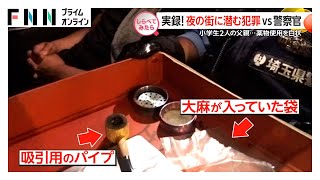
The man had tools used for smoking marijuana. But why were they still in his trunk?
“I didn’t have anywhere else to put them, and I thought I might need them again.”
Alongside drugs, another serious problem is illegal immigration.
Suddenly, a man bolts from the scene — a foreigner.
“This isn’t his neighborhood.”
“He’s an overstayer.”
The problem is deep-rooted.
“Do you have other friends?”
“Yes, lots of them.”
“Also overstayers?”
“Many. A lot.”
With this in mind, the patrol investigated what kinds of crimes hide in the city at night, and how police spot them.
At around 11 p.m. in Saitama, a black car left a convenience store.
“Look, one of the license plate lights is out.”
The officer noticed that one of the lights illuminating the license plate was broken. He signaled the driver to pull over.
“Please stop completely.”
Because the car was in violation of maintenance standards, the officer stopped it and spoke with the driver.
“You don’t often see this, but please fix it as soon as possible.”
The driver, a man in his 20s, appeared unaware that the light was out.
“I also don’t have my driver’s license with me.”
The man had committed two violations: driving with faulty equipment and not carrying his license.
The officer, sensing something suspicious, checked inside the car.
“What’s this? Pepper spray?”
Yes, a canister of pepper spray was found in a pocket beside the driver’s seat.
“Why do you have this?”
“For when someone tries to tailgate me.”
“I see. It’s for self-defense?”
“Yes.”
Even if it’s not used, carrying such an item in public without a legitimate reason can be a violation of the Minor Offenses Act.
“Please come with us to the station.”
“You’re not under arrest, but we need to investigate.”
Police escorted the man for questioning on suspicion of violating the Minor Offenses Act.
Just before 1 a.m. in Kawaguchi, officers on patrol spotted a man who, upon noticing the police car, suddenly ran away.
“What happened?”
“Why did you run?”
The man’s erratic behavior was suspicious. Officers followed him into a nearby building.
“Why did you run? What’s going on?”
The man, in his 20s and Vietnamese, was brought outside and questioned.
“Do you have a residence card?”
“No.”
“Are you sure?”
“Yes.”
“Do you have a visa?”
“No.”
After further questioning, the man finally admitted he had overstayed his visa.
“Are you overstaying?”
“Yes.”
Although he initially claimed there was “nothing” wrong, his passport revealed his visa had expired in 2023 — two years earlier. He had been working illegally at demolition sites since then.
While officers were questioning him, his phone rang repeatedly.
“Who’s calling you?”
“Friends.”
“Friends who are also overstayers?”
“Yes. Many.”
The man was arrested on the spot for violating immigration laws.
In another case at 9 p.m. in Kawaguchi, police attempted to question a Vietnamese man in a parking lot. The man ran, dropping his jacket as an officer grabbed it. He was eventually surrounded by police and collapsed on the road. His shoes and jacket were left behind during the chase.
“Are you overstaying?”
“Yes.”
Japan currently has around 75,000 people living illegally, some of whom are involved in criminal activities. Police are strengthening their crackdown on such offenses.
Drug crimes are another major focus of these patrols.
While on patrol, officers noticed a man trying to avoid eye contact. As they approached his vehicle, they asked, “Do you have anything dangerous in the car?”
The man complied at first but then became agitated.
“I’m in trouble.”
“Why are you in trouble?”
He tried to hide something inside the car.
“Police! Don’t resist!”
The officers restrained him, and after about 30 minutes, drug enforcement officers arrived.
“We suspect you’re involved with drugs.”
“Are you using?”
“No.”
“Are you carrying?”
“No.”
The man refused to provide a urine sample. However, over an hour later, his statements became vague.
“Did you use today?”
“I don’t know. Maybe three days ago.”
He eventually hinted that he had used drugs. The man, a single father, admitted he had turned to drugs due to stress from work.
A search of his bag revealed MDMA and methamphetamine. He was arrested on suspicion of violating the Stimulants Control Act. A woman with him also tested positive for drugs and was arrested.
Another patrol in Saitama stopped a black car leaving a parking lot after its driver appeared startled by police presence.
“Do you have anything dangerous with you?”
“No.”
But when asked to allow a search, the man became defensive.
“Please tell us what’s inside.”
“There’s nothing.”
“Are you sure?”
“Yes.”
The officer persisted, saying, “We can smell something.”
The man eventually admitted he had marijuana in his possession and had used it that day.
“How long have you been using?”
“For over a year.”
The man, a construction worker in his 30s, had two children in elementary school. The officer urged him to stop, warning, “If you keep this up, it could lead to stronger drugs like cocaine or methamphetamine, and then it’s too late.”
A further search of the car found marijuana residue under the seat. The man tested positive and was arrested.
Through these cases, the work of the Automobile Patrol Unit shows that crimes can be found in the most ordinary places. Police officers remain vigilant, noticing even the smallest irregularities to protect the safety of the community.
Source: FNN