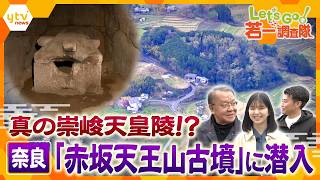

NARA, Apr 30 (News On Japan) - Sakurai City in Nara Prefecture, home to around 920 ancient burial mounds, has drawn renewed attention to one in particular, the Akasaka Tennozan Kofun, as researchers increasingly suggest it may be the true resting place of Emperor Sushun, who ascended the throne in the late sixth century with the backing of powerful statesman Soga no Umako.
Despite the existence of an officially designated imperial mausoleum managed by the Imperial Household Agency, questions persist over whether that site truly holds the emperor’s remains, with archaeological evidence pointing instead to the Akasaka Tennozan Kofun.
Japan is dotted with imperial tombs, most of which are strictly controlled and off-limits to the public, but the Akasaka Tennozan Kofun stands out as a rare exception, allowing entry into its interior, where investigators can directly examine its structure.
Located roughly 10 minutes by car from the officially recognized mausoleum in Kurahashi, the site offers a striking contrast, as no burial chamber or stone coffin matching imperial standards has been found at the government-designated tomb, while the Akasaka Tennozan Kofun features a massive stone chamber and sarcophagus consistent with those reserved for rulers of the highest rank.
The mound itself, constructed using a three-tiered layering technique, stretches approximately 50 meters and is designated as a national historic site, reflecting its scale and historical significance.
Access to the burial chamber requires crawling through a narrow entrance, at points just 50 centimeters high, before opening into a spacious interior chamber measuring about 6.5 meters in length and roughly 4 meters in height, with a total stone structure extending more than 15 meters.
Inside lies a large stone coffin believed to be of “imperial class,” with experts noting that such dimensions are typically reserved for rulers, reinforcing the theory that the site may indeed be linked to Emperor Sushun.
Recent research has also revealed that the stones within the chamber were originally coated in red pigment, a color historically associated with rebirth and regeneration, reflecting burial customs that date back to at least the third century.
Historical records indicate that Emperor Sushun died in 592, and the construction style of the tomb aligns with burial practices from the late sixth century, further strengthening the case for its identification as his final resting place.
According to historical accounts, Sushun is the only emperor explicitly recorded as having been assassinated, reportedly killed on the orders of Soga no Umako after tensions grew between the two, possibly triggered by remarks interpreted as hostile toward the powerful clan leader.
The sudden nature of the emperor’s death, with records suggesting he was buried without the customary mourning period, contrasts sharply with the scale of the tomb, leading some researchers to believe preparations for the burial site had already been underway prior to the assassination.
While no grave goods have been recovered due to the chamber having been looted in the past, scholars continue to examine both the archaeological evidence and historical texts, including references to Kurahashi as the burial location, to determine the tomb’s true occupant.
The question remains unresolved, with some experts suggesting that multiple factions within the imperial court may have been involved in the events leading to Sushun’s death, adding further complexity to the historical narrative.
As scientific methods advance, researchers hope that future studies may provide clearer answers, but for now, the Akasaka Tennozan Kofun remains one of Japan’s most intriguing archaeological mysteries, offering a rare glimpse into the burial practices and political tensions of the ancient era.
Source: YOMIURI