News On Japan

Komeito May Join Centrist Reform Alliance

TOKYO - Komeito has begun considering a plan under which all of its Upper House lawmakers would join the Centrist Reform Alliance, according to sources familiar with the discussions.

Secretary-General Nishida reportedly told party headquarters staff in Tokyo on the night of June 8th that if all 21 Komeito members in the House of Councillors were to join the alliance, the party could lose its status as a nationally recognized political party under Japan's political party requirements.

The potential move has raised questions about Komeito's future position in national politics and the impact such a large-scale realignment could have on the parliamentary landscape.

Meanwhile, the Constitutional Democratic Party of Japan is taking a cautious approach toward joining the centrist grouping and plans to carefully assess the proposal before making a decision.

Komeito is one of Japan's most influential postwar political parties, known for its centrist policies, emphasis on social welfare, and long-standing alliance with the Liberal Democratic Party (LDP).

The party was founded in 1964 by members of Soka Gakkai, a Buddhist lay organization that had grown rapidly in the years after World War II. Its name, Komeito, is commonly translated as "Clean Government Party," reflecting its original mission of promoting clean politics and combating corruption.

Komeito quickly expanded during the 1960s and 1970s, building a strong electoral base through Soka Gakkai's nationwide membership network. Concerns about the relationship between religion and politics led the party and Soka Gakkai to formally separate their organizational structures, although the two have remained closely connected.

In its early years, Komeito served as a moderate opposition party, positioning itself between the conservative LDP and the socialist parties. It advocated social welfare programs, support for ordinary households, educational assistance, and a pacifist approach to foreign and defense policy.

Japan's political landscape underwent a major realignment in the 1990s. Komeito dissolved as part of a broader restructuring of opposition forces in 1994 and later re-emerged as New Komeito in 1998. The party's modern role was cemented in 1999 when it entered a governing coalition with the LDP.

That alliance has become one of the defining features of modern Japanese politics. Although Komeito is much smaller than the LDP, its parliamentary seats have often been essential for maintaining stable governing majorities. As a result, the party has exerted influence well beyond its size, particularly on issues involving welfare spending, education, healthcare, and security policy.

Komeito has frequently acted as a moderating force within coalition governments. While supporting Japan's alliance with the United States, it has generally advocated caution on military issues and emphasized diplomacy, humanitarian assistance, and constitutional restraint.

The party's electoral strength has long depended on Soka Gakkai's highly organized grassroots network, which has helped deliver reliable voter turnout in elections. This support base allowed Komeito to remain a significant political force even without the broad national support enjoyed by the LDP.

In recent years, Komeito has faced challenges as Japan's population ages and the Soka Gakkai membership base gradually declines. Even so, it remains a key player in national politics because of its role in coalition governments and its ability to mobilize supporters.

More than six decades after its founding, Komeito continues to occupy a unique position in Japanese politics as a centrist party that often serves as the balance between larger political forces while advocating social welfare, moderation, and political stability.

Source: テレ東BIZ

News On Japan
POPULAR NEWS

A powerful earthquake registering a maximum intensity of 6 upper on Japan’s seismic scale struck Aomori Prefecture at around 7:30 a.m. today. According to the Japan Meteorological Agency, the epicenter was off the coast of Iwate Prefecture, with a depth of about 50 kilometers. The earthquake’s magnitude was estimated at 6.9.

As of 5 a.m. on June 25, Typhoon No. 7, Mekkhala, was south of Okinawa, moving slowly north with strong intensity, and is expected to move north east of Miyakojima in Okinawa Prefecture later in the day before passing west of Okinawa’s main island, bringing storm-force winds and heavy rain. Typhoon No. 8, Higos, located farther east of the Philippines, is not expected to develop significantly.

The sale of religious corporations that operate temples and shrines across Japan is drawing growing scrutiny from authorities, who fear the transactions could be used for tax evasion and money laundering, as brokers openly advertise properties and corporate status for tens or even hundreds of millions of yen.

Nine Japanese nationals were among 17 people detained in Laos on suspicion of involvement in a special fraud operation, while Japanese authorities have sought cooperation from Cambodian police over dozens of Japanese citizens believed to have gone missing after traveling to Cambodia.

Japan will begin a new system on June 23 to sell paint and thinner directly from manufacturers to construction firms and other businesses, aiming to ease supply bottlenecks and curb price increases as worsening conditions in the Middle East make such materials harder to obtain.

MEDIA CHANNELS
         

MORE Politics NEWS

The Takaichi government said on June 24 that public and private investment in 17 strategic fields, including AI and semiconductors, is expected to exceed 370 trillion yen by 2040, as it seeks to draw out private-sector spending and turn advanced technologies into economic growth.

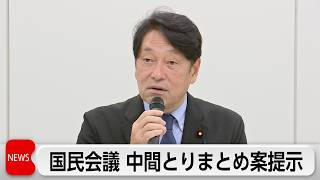
A cross-party national council discussing a reduction in the consumption tax on food will present a draft proposal on June 24 calling for the rate to be lowered to 1% from April next year.

The speakers and vice speakers of both houses of the Japanese Diet approved on June 22 the government’s outline for revising the Imperial Household Law and related measures aimed at securing the number of imperial family members, following what has been described as the consensus of the legislature.

Centrist Reform Alliance leader Ogawa has secured agreement from the leaders of the Constitutional Democratic Party of Japan and Komeito to establish a consultative body to discuss a possible merger of the three parties.

A bill to revise the national referendum law, which sets procedures for constitutional amendments, was approved by the House of Representatives plenary session and is expected to enter deliberation at the House of Councillors Commission on the Constitution on June 24.

A draft of the joint statement from the G7 summit in France has revealed that all proposals put forward by Prime Minister Takaichi on energy security and critical minerals have been incorporated into the agreement.

Powerful gathering at the G7 Summit in Evian-les-Bains as President Donald Trump, Emmanuel Macron, Keir Starmer, Friedrich Merz, Giorgia Meloni, Sanae Takaichi, Mark Carney, Ursula von der Leyen, Antonio Costa, Sheikh Tamim bin Hamad Al Thani, Sheikh Mohamed bin Zayed Al Nahyan and Abdel Fattah al-Sisi attend a high-level working lunch.

Prime Minister Sanae Takaichi and Italian Prime Minister Giorgia Meloni announced new agreements on supply chain resilience and space cooperation following a summit meeting in Italy on June 15th, as the two countries pledged closer coordination on economic security and international affairs ahead of the G7 Summit.