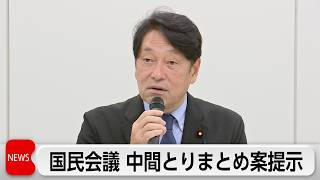
TOKYO - Centrist Reform Alliance leader Ogawa has secured agreement from the leaders of the Constitutional Democratic Party of Japan and Komeito to establish a consultative body to discuss a possible merger of the three parties.
Ogawa met separately with the leaders of the CDP and Komeito and called for the creation of a framework to examine how the three parties could come together. "We are firmly determined to discuss organizational issues among the three parties from the perspective of what our centrist and liberal forces should become," Ogawa said.
At the meetings, the three parties confirmed a policy of advancing talks through a joint consultative body on issues including policy, elections and organizational structure. Ogawa wants the three parties to reach a conclusion on the proposed merger during the current Diet session.
Komeito has shown a positive stance toward the merger, but within the CDP, some sitting Diet members and local organizations have voiced caution, raising the prospect that the negotiations could face twists and turns.
Centrist Reform Alliance
The Centrist Reform Alliance’s strength is that it gives the merger a clear unifying slogan: "livelihood-first" politics, pragmatic reform, constitutionalism, social inclusion, realistic security policy, energy security and political reform. That is broad enough to attract CDP liberals and Komeito moderates, and it avoids sounding ideological. Its proposed permanent abolition of consumption tax on food and lower social insurance premiums could be attractive to households hit by inflation.
The weakness is credibility. A platform that promises lower taxes, lower social insurance burdens, stronger welfare, investment, energy security and fiscal responsibility risks looking like a collection of popular pledges unless the funding is highly convincing. The party says it would avoid reliance on government bonds and use ideas such as a "Japan Fund," but that may be attacked as vague or financially optimistic. Its other problem is identity: if it is designed to absorb both CDP and Komeito elements, it may struggle to explain what makes it more than a compromise vehicle.
Constitutional Democratic Party of Japan
The CDP’s strongest policy identity is its focus on constitutionalism, workers, households, small businesses, wage growth, tax fairness and scrutiny of government power. Its 2026 tax proposal emphasizes "bottom-up economic growth," support for households and small and midsize companies, temporary zero consumption tax on food from October 2026, abolition of provisional gasoline and diesel tax rates, and withdrawal of defense-related tax increases.
The critique is that the CDP often faces a tension between principled opposition and governing credibility. Its policies are strong on redistribution, consumer relief and fairness, but critics can question whether they add up to a convincing growth strategy or a fully funded fiscal plan. In the merger context, the bigger problem is internal consistency: the party’s own 2026 activity plan acknowledges that the earlier process around the Centrist Reform Alliance was rushed, poorly explained to supporters and local organizations, and left voters unclear about the party’s identity. That makes another merger push politically risky unless the leadership can clearly explain what CDP voters are being asked to support.
Komeito
Komeito’s policy strength is its long-standing emphasis on welfare, education support, peace, social stability and practical coalition politics. It has pushed issues such as school lunch fee relief, high school tuition support, high-cost medical expense protections, lower social insurance burdens, selective separate surnames for married couples, nuclear disarmament and coexistence with foreign residents.
The weakness is that Komeito’s moderation can look blurred. It often presents itself as a brake on harsher policies and a protector of vulnerable households, but years of coalition-style politics can make it harder to claim a clean reform identity. In a merger with CDP and the Centrist Reform Alliance, Komeito may bring organizational discipline and policy pragmatism, but it also risks alienating supporters who value its distinct religious-cultural roots, peace orientation and incremental approach. Its challenge is to show that joining a broader centrist-liberal bloc strengthens, rather than dilutes, its identity.
Overall, the policy fit is plausible on livelihood support, education, welfare, political reform and moderate constitutionalism. The main fault lines are fiscal realism, security policy, party identity and whether local organizations can accept a merger designed mainly by national leaders.
Source: テレ東BIZ