News On Japan

Earthquake Shakes Gunma and Saitama, Reaching Lower-5 Intensity

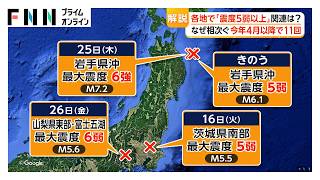
GUNMA - A magnitude 5.5 earthquake struck eastern Japan at around 7:46 p.m., with a maximum seismic intensity of lower 5 recorded in parts of Gunma and Saitama prefectures, though no injuries or major damage had been confirmed and there was no risk of a tsunami.

According to the Japan Meteorological Agency, the earthquake's epicenter was in southern Ibaraki Prefecture at a depth of approximately 50 kilometers.

The strongest shaking, measuring lower 5 on Japan's seismic intensity scale, was recorded in Ota City and Chiyoda Town in Gunma Prefecture, and in Kazo City, Honjo City, and Misato Town in Saitama Prefecture. Intensity 4 shaking was observed across parts of Ibaraki, Tochigi, and southern Saitama prefectures, while intensity 3 was felt in Tokyo's 23 wards and surrounding areas.

The Fire and Disaster Management Agency said no injuries or building damage had been confirmed as of the latest reports.

The earthquake also affected transportation. East Japan Railway said services on portions of the Hokuriku and Joetsu Shinkansen lines were suspended in both directions following the tremor, with operations expected to resume at around 10:15 p.m.

Seismologists noted that the earthquake originated in a seismically active area near the boundary where the Philippine Sea Plate subducts beneath the continental plate. A similar earthquake measuring lower 5 on the Japanese scale occurred in nearly the same area on April 1, suggesting the latest event was caused by comparable tectonic activity.

Experts said the region frequently experiences earthquakes of intensity 3 or greater and is considered one of the more active seismic zones in the Kanto region. The latest quake is believed to have been a reverse-fault event caused by compressional forces generated by plate movement.

Long-period ground motion, classified at the lowest level on Japan's scale, was also observed in southern Gunma, northern Saitama, and nearby areas. Such shaking can cause taller buildings to sway slowly for extended periods even when overall seismic intensity is relatively moderate.

Reports from residents indicated that many people near the epicenter experienced a sharp upward jolt followed by rapid shaking. Experts said short-period vibrations can cause unsecured household items to fall, increasing the risk of injuries inside homes even when structural damage is limited.

Authorities advised residents returning home to remain cautious of broken glass and fallen objects. Seismologists also warned that earthquakes of similar strength could occur over the coming week and that smaller aftershocks remain possible. They urged people to secure unstable items that may have shifted during the quake, as additional tremors could cause them to fall.

Analysis of seismic data indicated that many areas first experienced small, rapid vibrations before stronger shaking arrived, a pattern consistent with observations from residents across the affected region. Experts said the area is likely to remain susceptible to further seismic activity and urged continued vigilance in the days ahead.

Source: ウェザーニュース

News On Japan
POPULAR NEWS

Typhoon No. 9 Bavi had intensified into a violent typhoon near the Truk Islands by the afternoon of July 4 and is forecast to strengthen further before passing near Guam and Saipan, with the storm potentially approaching Okinawa and the Sakishima Islands from around July 10 to July 11.

A fossil discovered in Osaka has led to Japan’s first finding of its kind, raising the possibility that a giant marine predator believed to have swum in the seas around the Kansai region about 70 million years ago was a previously unknown species.

Former Nissan Motor Chairman Carlos Ghosn said the automaker is in a "state of emergency" and signaled he would be willing to return as chief executive officer, arguing that only a true decision-maker in the CEO role could rescue the company.

The entire Negishi Housing Area in Yokohama, Kanagawa Prefecture, has been returned to Japan for the first time in 79 years, ending its use as a residential district for U.S. military personnel and their families.

Strong earthquakes have continued to shake parts of Japan in recent weeks, with 11 temblors measuring lower 5 or above on the Japanese seismic intensity scale recorded across the country since April 2026.

MEDIA CHANNELS
         

MORE Travel NEWS

Oiso Long Beach, a popular summer destination in Oiso, Kanagawa Prefecture, opened its pools for the season on July 4, drawing about 1,300 visitors as the facility strengthened heatstroke prevention measures.

A bear was seen walking openly through a residential street in Tsuruoka, Yamagata Prefecture, on the morning of July 3, appearing in a popular hot spring area with a history of 1,200 years that attracts many tourists.

Mount Fuji’s Yoshida Route on the Yamanashi Prefecture side opened for the climbing season on July 1, with favorable weather at the 3,776-meter summit giving visitors a clear view of the sunrise at around 4:30 a.m. as sunlight broke through gaps in the clouds.

A man in his 70s was injured early on June 30 after being attacked by a bear near an elementary school in Tochigi Prefecture, as bear-related incidents continue to rise across Japan ahead of the full onset of summer heat in July.

Japan’s tourism recovery has entered a new phase in 2026, marked not just by rising visitor numbers but by a deeper structural shift in how the country manages entry procedures.

Kyoto’s Gion Festival, one of Japan’s three major festivals, began on July 1 with the Osendo ritual at Yasaka Shrine, where the child messenger and his attendants prayed for the safe completion of their major role in the monthlong event.

A Kintetsu Railway train derailed inside Kyoto Station on the morning of June 29, forcing partial suspensions on the Kintetsu Kyoto Line for the rest of the day and causing long delays that hit commuters, students and tourists.

A section of stone wall at Hikone Castle, one of Japan’s few surviving original Edo-period castles and a National Treasure whose main keep remains intact more than 400 years after its construction, collapsed after heavy rain caused by Typhoons No. 7 and No. 8, Hikone city officials said.