News On Japan

Volcanic Alert Raised Ahead of Hokkaido Hiking Sesson

HOKKAIDO - The eruption alert level for Mount Tokachidake in Hokkaido was raised to Level 2 on June 18 for the first time in 12 years, prompting authorities to restrict entry within 1.5 kilometers of the crater and close parts of hiking trails just days before the mountain’s official opening for the summer climbing season.

The mountain rises east of Biei, known for its popular Blue Pond, and Kamifurano, where lavender fields are set to come into bloom. The Sapporo Regional Headquarters of the Japan Meteorological Agency said volcanic activity at Tokachidake had become more active, raising the alert from Level 1 to Level 2.

"Volcanic activity is increasing, and there is a possibility of an eruption that could affect areas within about 1.5 kilometers of the crater," said Yuji Takahashi, volcanic disaster prevention coordination officer at the Sapporo Regional Headquarters.

Tokachidake is scheduled to open for the climbing season in three days, but entry is now restricted within a 1.5-kilometer radius of the crater. Biei and Kamifurano, which have hiking routes on the mountain, as well as Shintoku in the Tokachi region, have partially closed trails and installed signs urging caution.

Some climbers who visited without knowing the alert level had been raised expressed surprise. "Does that mean we can’t go to the summit?" one climber from Gunma Prefecture said. Another said, "The smoke is really intense. Even when we were moving by car, there was a smell."

Tokachidake has repeatedly erupted at intervals of about 30 years. Hiroshi Aoyama, a professor at Hokkaido University’s Institute of Seismology and Volcanology, said he is particularly concerned about the increase in volcanic gas.

"Tokachidake has been releasing a very large amount of volcanic gas since late April," Aoyama said. "More than 1,000 tons of sulfur dioxide are being emitted each day, producing a very strong irritating odor that is not good for the body. Thermal activity around the crater has also remained high, so overall I believe the mountain is becoming more active."

The restriction applies to the area within a 1.5-kilometer radius of the 62-2 crater at Tokachidake. Hiking trails passing through the zone were closed from June 18.

The surrounding area includes hot spring resorts such as Shirogane Onsen, Fukiage Onsen and Tokachidake Onsen, as well as tourist sites including the Blue Pond, which is popular with visitors from overseas. Authorities said there is currently no impact on these areas. The urban area of Kamifurano, where many residents live, is about 15 kilometers from the crater and is also not affected at this time.

Aoyama said residents should use the alert as an opportunity to review emergency procedures. "While paying attention to the condition of the mountain, it would be good for residents to once again review evacuation routes and how to respond in an emergency," he said.

Officials said excessive concern is not necessary as the region enters the tourism season, but volcanic activity can change at any time. Visitors and nearby residents are being urged to check evacuation routes and confirm in advance how they would respond in an emergency while continuing to monitor developments at Tokachidake.

北海道の夏山シーズン前に十勝岳の噴火警戒レベル引き上げ

北海道の十勝岳で6月18日、噴火警戒レベルが12年ぶりに「2」へ引き上げられ、夏山シーズンの山開きを数日後に控える中、当局は火口から1.5キロ以内の立ち入りを規制し、登山道の一部を閉鎖しました。

北海道登山季前夕十胜岳火山警戒级别上调

北海道十胜岳的火山喷发警戒级别于6月18日时隔12年上调至2级,距离夏季登山季正式开山仅剩数日,当局已限制人员进入火山口方圆1.5公里范围,并关闭部分登山路线。

Source: Hokkaido News UHB

News On Japan
POPULAR NEWS

Typhoon No. 9 Bavi had intensified into a violent typhoon near the Truk Islands by the afternoon of July 4 and is forecast to strengthen further before passing near Guam and Saipan, with the storm potentially approaching Okinawa and the Sakishima Islands from around July 10 to July 11.

A fossil discovered in Osaka has led to Japan’s first finding of its kind, raising the possibility that a giant marine predator believed to have swum in the seas around the Kansai region about 70 million years ago was a previously unknown species.

Former Nissan Motor Chairman Carlos Ghosn said the automaker is in a "state of emergency" and signaled he would be willing to return as chief executive officer, arguing that only a true decision-maker in the CEO role could rescue the company.

The entire Negishi Housing Area in Yokohama, Kanagawa Prefecture, has been returned to Japan for the first time in 79 years, ending its use as a residential district for U.S. military personnel and their families.

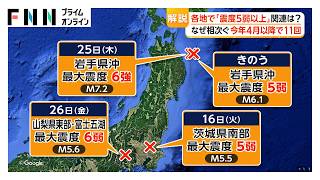
Strong earthquakes have continued to shake parts of Japan in recent weeks, with 11 temblors measuring lower 5 or above on the Japanese seismic intensity scale recorded across the country since April 2026.

MEDIA CHANNELS
         

MORE Travel NEWS

Oiso Long Beach, a popular summer destination in Oiso, Kanagawa Prefecture, opened its pools for the season on July 4, drawing about 1,300 visitors as the facility strengthened heatstroke prevention measures.

A bear was seen walking openly through a residential street in Tsuruoka, Yamagata Prefecture, on the morning of July 3, appearing in a popular hot spring area with a history of 1,200 years that attracts many tourists.

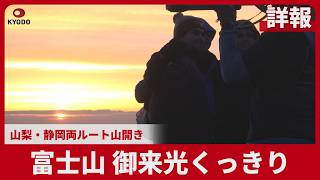
Mount Fuji’s Yoshida Route on the Yamanashi Prefecture side opened for the climbing season on July 1, with favorable weather at the 3,776-meter summit giving visitors a clear view of the sunrise at around 4:30 a.m. as sunlight broke through gaps in the clouds.

A man in his 70s was injured early on June 30 after being attacked by a bear near an elementary school in Tochigi Prefecture, as bear-related incidents continue to rise across Japan ahead of the full onset of summer heat in July.

Japan’s tourism recovery has entered a new phase in 2026, marked not just by rising visitor numbers but by a deeper structural shift in how the country manages entry procedures.

Kyoto’s Gion Festival, one of Japan’s three major festivals, began on July 1 with the Osendo ritual at Yasaka Shrine, where the child messenger and his attendants prayed for the safe completion of their major role in the monthlong event.

A Kintetsu Railway train derailed inside Kyoto Station on the morning of June 29, forcing partial suspensions on the Kintetsu Kyoto Line for the rest of the day and causing long delays that hit commuters, students and tourists.

A section of stone wall at Hikone Castle, one of Japan’s few surviving original Edo-period castles and a National Treasure whose main keep remains intact more than 400 years after its construction, collapsed after heavy rain caused by Typhoons No. 7 and No. 8, Hikone city officials said.