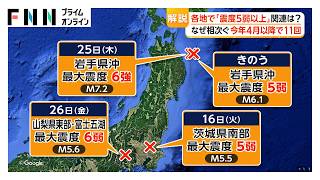
YAMANASHI - Japan’s weather agency carried out field inspections in Yamanashi Prefecture on June 28 after a powerful earthquake struck the Fuji Five Lakes area late on June 26, registering a lower 6 on Japan’s seismic intensity scale in Fujikawaguchiko and injuring six people.
The earthquake occurred at around 10:28 p.m. on June 26 with its focus in eastern Yamanashi and the Fuji Five Lakes region. The Japan Meteorological Agency put the magnitude at 5.6 and the depth at about 20 kilometers. There was no risk of a tsunami.
The strongest shaking was recorded in Fujikawaguchiko, where the quake reached lower 6 on the Japanese scale. Otsuki recorded upper 5, while Kofu, Fujiyoshida and other areas observed lower 5. Tremors were felt across a wide area from the Tohoku region to western Japan.
In response, a survey team from the Kofu Local Meteorological Office visited seismic intensity meters installed in Fujikawaguchiko and Otsuki on June 28. Officials checked whether the devices had operated normally and whether there was any damage around the observation points.
The inspection was intended to confirm that the recorded intensity values accurately reflected the shaking at each location. The team examined the condition of the equipment and its surroundings, including whether anything nearby may have affected the readings.
Damage to buildings was confirmed in Kofu and other areas after the quake, while six people were reported injured. The Japan Meteorological Agency said no unusual changes had been observed at Mount Fuji following the earthquake.
According to the agency, two earthquakes with an intensity of 1 or higher had been recorded by midnight after the main quake, including one that reached intensity 3 and one that reached intensity 1. Long-period ground motion at level 1 was observed in eastern and western Kanagawa, central and western Yamanashi, eastern Yamanashi and the Fuji Five Lakes area, and eastern Shizuoka.
The agency is urging residents in areas hit by strong shaking to remain alert for about a week, warning that earthquakes of similar intensity could still occur. It also said the quake may have loosened ground in some areas, increasing the risk of landslides, especially if rain falls over already weakened slopes.
Officials advised people not to enter dangerous areas unless absolutely necessary and to pay close attention to future seismic activity and weather conditions. The warning comes as parts of central Japan continue to face elevated risks from rain and unstable ground following recent severe weather.
The earthquake was caused by a reverse fault-type movement with a pressure axis running northwest to southeast, according to the agency’s preliminary analysis. The focus was in an inland area near the northern foot of Mount Fuji, a region where strong shaking can affect both residential districts and major tourism routes around the Fuji Five Lakes.
For residents and visitors, authorities are calling for continued caution, including checking for damage inside homes, securing furniture and avoiding slopes, cliffs and damaged structures. The agency said people should be prepared for further shaking and should follow local evacuation and safety information if conditions worsen.
Source: TBS