News On Japan

Okinawa Rainy Season Ends 22 Days Later Than Last Year

NAHA - The Japan Meteorological Agency said at around 2 p.m. on June 29 that the rainy season appeared to have ended in Okinawa, marking a later-than-usual start to summer after an especially wet period.

The end of the rainy season came eight days later than in an average year and 22 days later than in 2025.

Rainfall during the rainy season in Naha, Okinawa Prefecture, totaled 854 millimeters, about 1.7 times the normal level.

Okinawa is expected to remain under the influence of a high-pressure system, bringing widespread summer skies. In Naha, the mercury is forecast to reach 32 degrees on June 30, with midsummer-like days expected to continue.

Source: FNN

News On Japan
POPULAR NEWS

Typhoon No. 9 Bavi had intensified into a violent typhoon near the Truk Islands by the afternoon of July 4 and is forecast to strengthen further before passing near Guam and Saipan, with the storm potentially approaching Okinawa and the Sakishima Islands from around July 10 to July 11.

A fossil discovered in Osaka has led to Japan’s first finding of its kind, raising the possibility that a giant marine predator believed to have swum in the seas around the Kansai region about 70 million years ago was a previously unknown species.

Former Nissan Motor Chairman Carlos Ghosn said the automaker is in a "state of emergency" and signaled he would be willing to return as chief executive officer, arguing that only a true decision-maker in the CEO role could rescue the company.

The entire Negishi Housing Area in Yokohama, Kanagawa Prefecture, has been returned to Japan for the first time in 79 years, ending its use as a residential district for U.S. military personnel and their families.

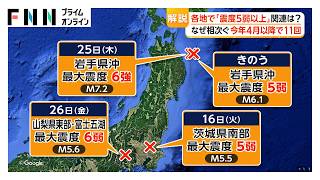
Strong earthquakes have continued to shake parts of Japan in recent weeks, with 11 temblors measuring lower 5 or above on the Japanese seismic intensity scale recorded across the country since April 2026.

MEDIA CHANNELS
         

MORE Travel NEWS

Oiso Long Beach, a popular summer destination in Oiso, Kanagawa Prefecture, opened its pools for the season on July 4, drawing about 1,300 visitors as the facility strengthened heatstroke prevention measures.

A bear was seen walking openly through a residential street in Tsuruoka, Yamagata Prefecture, on the morning of July 3, appearing in a popular hot spring area with a history of 1,200 years that attracts many tourists.

Mount Fuji’s Yoshida Route on the Yamanashi Prefecture side opened for the climbing season on July 1, with favorable weather at the 3,776-meter summit giving visitors a clear view of the sunrise at around 4:30 a.m. as sunlight broke through gaps in the clouds.

A man in his 70s was injured early on June 30 after being attacked by a bear near an elementary school in Tochigi Prefecture, as bear-related incidents continue to rise across Japan ahead of the full onset of summer heat in July.

Japan’s tourism recovery has entered a new phase in 2026, marked not just by rising visitor numbers but by a deeper structural shift in how the country manages entry procedures.

Kyoto’s Gion Festival, one of Japan’s three major festivals, began on July 1 with the Osendo ritual at Yasaka Shrine, where the child messenger and his attendants prayed for the safe completion of their major role in the monthlong event.

A Kintetsu Railway train derailed inside Kyoto Station on the morning of June 29, forcing partial suspensions on the Kintetsu Kyoto Line for the rest of the day and causing long delays that hit commuters, students and tourists.

A section of stone wall at Hikone Castle, one of Japan’s few surviving original Edo-period castles and a National Treasure whose main keep remains intact more than 400 years after its construction, collapsed after heavy rain caused by Typhoons No. 7 and No. 8, Hikone city officials said.