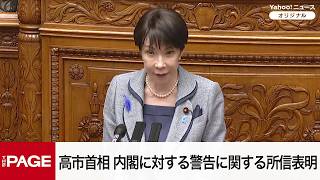
TOKYO - Prime Minister Sanae Takaichi’s political agenda faced pressure on several fronts on July 3, as the government kept open the possibility of currency intervention to support the yen, opposition parties continued to challenge the ruling bloc’s management of the Diet, and Japan moved to extend its security diplomacy through India and NATO-related talks.
The most immediate political issue was the yen. Finance Minister Satsuki Katayama said Japan was ready to respond appropriately to excessive currency moves and remained in close contact with U.S. authorities, keeping alive the possibility of intervention after the yen traded near historically weak levels against the dollar.
The currency issue has become a political problem for the Takaichi administration because yen weakness is feeding higher import costs, squeezing households and putting pressure on smaller companies. While a weaker yen supports exporters and inbound tourism, it also raises the price of food, energy and raw materials, making it harder for the government to argue that its growth strategy is improving living standards.
Katayama’s comments came as the administration tries to balance three difficult goals: keeping investment conditions supportive, preserving confidence in public finances and preventing the yen from falling far enough to damage household purchasing power. The government has also stressed its commitment to fiscal health after bond market concerns over Takaichi’s spending plans pushed Japanese government bond yields higher.
The yen debate is closely tied to the Bank of Japan. The central bank raised its policy rate to 1% in June, the highest level in more than three decades, but the government’s economic program depends on large-scale investment through fiscal 2040. That has sharpened attention on whether the BOJ will continue raising rates or move more cautiously as the administration pushes its growth strategy.
Fresh wage data strengthened the case for further BOJ normalization. Japan’s largest labor union group said companies agreed to average wage increases of 5.01% this year, marking the third consecutive year that pay hikes exceeded 5%. Sustained wage growth is one of the BOJ’s key conditions for raising rates, but it also gives the government a political argument that Japan is finally moving toward a more durable wage-price cycle.
For Takaichi, the risk is that wage gains may not feel meaningful to households if the weak yen continues to drive up import prices. The administration needs wage growth to support consumption, but it also needs currency stability to prevent inflation from becoming politically toxic.
The Diet remained another major source of pressure. Opposition parties have continued to criticize the ruling Liberal Democratic Party and its coalition partner, the Japan Innovation Party, over what they describe as heavy-handed parliamentary management. Lower House Speaker Fukushiro Nukaga has urged parties to end the impasse, but opposition demands for intensive Budget Committee deliberations attended by Takaichi and for party leader debates remain unresolved.
The standoff has raised questions over how much of the government’s legislative agenda can be completed before the current Diet session ends on July 17. The ruling bloc wants to prioritize legislation related to the Imperial House while accepting a pause in debates on bills to reduce Lower House seats and establish a secondary capital.
The Imperial House bill is politically sensitive because it touches on the long-term stability of the imperial succession system. The LDP’s decision to prioritize the measure reflects the party’s conservative base and its desire to make progress on institutional issues before the session closes. At the same time, shelving or delaying other bills could expose tensions with Ishin, which has strongly promoted administrative reform, regional decentralization and the secondary capital concept.
Opposition realignment also remained in focus. Yuichiro Tamaki, leader of the Democratic Party for the People, expressed reluctance to join the ruling coalition, citing dissatisfaction with the ruling camp’s Diet management. His stance matters because the DPFP can sometimes influence policy debates on wages, tax relief, energy and household support, even without entering government.
Tamaki’s hesitation suggests that Takaichi may struggle to broaden her parliamentary base beyond the LDP-Ishin framework if the government is seen as forcing bills through the Diet. The ruling coalition has numerical strength, but political stability also depends on whether moderate opposition parties see any benefit in cooperation.
Foreign and security policy gave the administration a more positive line. Takaichi’s India visit produced agreements to deepen cooperation in artificial intelligence, metals, energy, defense and economic security. Japan and India also adopted documents on economic security, energy resilience and AI, and signed their first defense co-development agreement.
The India summit fits neatly into Takaichi’s political narrative. Her administration is trying to present economic security, industrial investment and defense cooperation as parts of the same strategy. India gives Japan a major partner outside China for supply chains, technology, infrastructure and Indo-Pacific security.
The summit also gives Takaichi a way to show that Japan is responding to China’s pressure not only through protests but through alternative partnerships. Beijing’s recent export controls on Japanese entities have strengthened the political case for supply-chain resilience, especially in dual-use technologies, critical materials and advanced manufacturing.
Japan’s diplomacy will continue next week when Foreign Minister Toshimitsu Motegi and Defense Minister Shinjiro Koizumi travel to Ankara to attend NATO summit-related events. Takaichi is expected to skip the NATO summit itself, prioritizing Diet proceedings before the session ends, but sending the foreign and defense ministers allows Japan to remain present in alliance discussions.
The move reflects the balancing act facing the administration. Takaichi wants Japan to appear active in global security diplomacy, but she also needs to manage the Diet at home as opposition parties push for her direct attendance in parliamentary deliberations.
The July 3 political picture therefore shows an administration trying to hold together a broad strategy under growing pressure. The yen is testing the economic side of Takaichi’s agenda. The Diet impasse is testing her parliamentary control. China tensions and the India summit are reinforcing her security narrative. The BOJ’s next moves could determine whether the government’s growth plan is supported by stable financial conditions or complicated by higher rates and currency volatility.
What To Watch Next
The yen remains the most immediate political and market issue. Any renewed slide could increase pressure on the Finance Ministry to intervene and on the BOJ to explain how currency weakness affects its rate outlook.
The BOJ’s July 30-31 policy meeting is becoming a major political marker, especially after strong wage data and continuing concern over import-driven inflation.
The Diet session ends on July 17, leaving little time for the government to resolve the opposition boycott, hold intensive committee deliberations and advance priority bills.
The Imperial House legislation will be watched closely as the LDP seeks to prioritize conservative institutional issues while managing coalition tensions with Ishin.
Japan’s follow-through from the India summit will matter for Takaichi’s economic security agenda, particularly in AI, critical minerals, energy resilience and defense co-development.
Motegi and Koizumi’s NATO-related visit to Turkey will show how Japan maintains security diplomacy while Takaichi stays focused on domestic Diet management.