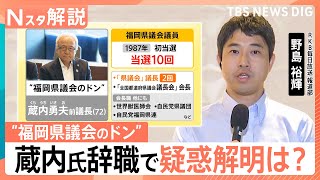


FUKUOKA - Former Fukuoka Prefectural Assembly speaker Isao Kuranouchi, long regarded as the dominant power in the chamber, resigned as an assembly member on August 25, intensifying scrutiny of allegations involving financial transactions, costly overseas inspection trips and policies backed by public funds while raising broader questions about how he accumulated such influence.
Following Kuranouchi's resignation, the Liberal Democratic Party group, the largest faction in the Fukuoka Prefectural Assembly, held an emergency meeting as the chamber sought ways to restore public trust.
Kuranouchi, 72, was first elected to the prefectural assembly in 1987 at age 33 and won election 10 times.
During his long political career, he served twice as speaker of the Fukuoka Prefectural Assembly and also headed the National Association of Chairpersons of Prefectural Assemblies.
He additionally held leadership positions in the World Veterinary Association, the LDP group in the Fukuoka Prefectural Assembly and the party's Fukuoka prefectural organization, contributing to his reputation as the "don" of Fukuoka prefectural politics.
His prolonged tenure as head of the LDP's Fukuoka organization was unusual because such prefectural party posts are often held by national lawmakers in other regions.
Kuranouchi instead remained chairman for more than 10 years while serving as a prefectural assembly member, giving him considerable influence over both the assembly and the local party organization.
Political observers and people familiar with the assembly said Kuranouchi's power had become so extensive that some lawmakers found it difficult to openly challenge him.
A reporter who previously worked for the Fukuoka prefectural government said the prefectural assembly had long exercised substantial influence over the administration and that the LDP assembly group led by Kuranouchi was particularly powerful.
The controversy surrounding Kuranouchi was highlighted on August 17, when a scheduled vote on a resolution recommending his resignation as assembly speaker was halted.
An emergency motion proposing that the vote be canceled was submitted by Fukuoka assembly member Taisuke Hayashi, a former secretary to Kuranouchi.
The atmosphere in the chamber was described as tense, with some LDP members reportedly standing to support the emergency motion with stern expressions.
The LDP group had imposed party discipline on the vote, meaning members who opposed the party's position could potentially face punishment.
Some lawmakers were therefore believed to have voted for the motion despite personally opposing it.
The political pressure was particularly significant because unified local elections, including the next Fukuoka Prefectural Assembly election, are scheduled for spring 2027.
Some members were believed to have faced a difficult choice between concerns over how voters would view their actions and the consequences of defying the party leadership.
Attention is now turning to whether Kuranouchi's resignation will affect efforts to establish the facts surrounding several controversies involving the prefectural assembly.
One involves allegations of about 28 million yen in financial transactions connected with the allocation of the assembly's speaker and deputy speaker posts.
Another concerns 25 overseas inspection trips over three years that reportedly cost about 280 million yen.
Questions have also been raised about the validity of spending under Fukuoka's One Health policy, including a monument costing 350 million yen.
Kuranouchi has said he will cooperate with an investigation by an independent third-party committee, but such a panel has no compulsory investigative powers.
The resignation has therefore raised concerns that establishing the full facts could become more difficult now that he has left the assembly.
The controversy is also being viewed as a broader issue extending beyond Kuranouchi personally.
Critics argue that the concentration of power within the assembly and the limited transparency surrounding political spending helped create an environment in which the allegations could emerge.
Local assemblies have long faced criticism that transparency over money can be weaker than at the national Diet level, prompting calls for Fukuoka Prefecture and other local governments to reconsider their systems and rules.
The dispute has also renewed debate over the proper relationship between elected assemblies and government administrations, which are expected to maintain a degree of tension and mutual oversight rather than allowing one political group or individual to become overwhelmingly dominant.
Source: TBS