
News On Japan

Squids Attract Mates with Stylish Ink: Heart Marks as Love Signals

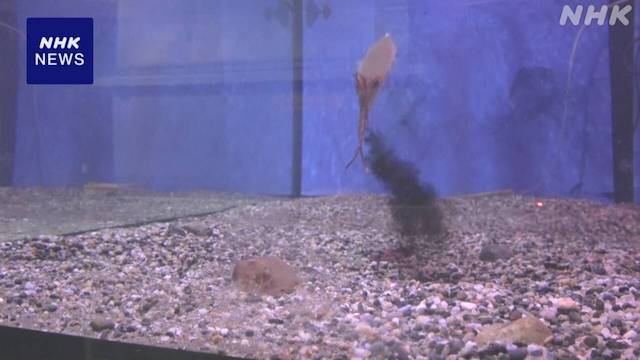
TOKYO - A research group from the University of Tokyo and others has announced that squid, which are known to eject ink to confuse predators and escape, also use the ink in a courtship behavior to make themselves more conspicuous and appeal to females.
Squids Attract Mates with Stylish Ink: Heart Marks as Love Signals

This is the first time such courtship behavior has been confirmed, and the research group hopes it will aid in the understanding of the evolution of animal communication.

Graduate students from the University of Tokyo, including Arata Nakayama, focused on a species of squid called the Gonatus squid, observing the males as they courted females by touching them with two special tentacles while ejecting ink. They found that the males would stroke the females with their tentacles for an extended period and emit small blobs of ink before finally spreading ink over a wide area to darken the background and then making their bodies shine white to court the females. According to the research group, this is the first time squid have been observed using ink for courtship behavior. Associate Professor Yoko Iwata of the University of Tokyo's Atmosphere and Ocean Research Institute said, "I was very surprised to find that squid, which have high intelligence, have repurposed ink originally used for escape for courtship behavior. Being able to immediately set the stage when they want to court is a significant advantage and will help us understand the evolution of animal communication."

The Gonatus squid, which measures about 12 centimeters in length, inhabits the sea at a depth of around 50 meters from southern Hokkaido to the Philippines, but its detailed ecology is still not well understood. The Aomori Prefectural Asamushi Aquarium, which was the first to successfully breed this species of squid in Japan, made headlines in 2019 when it captured footage of a male using its short tentacles to form a "heart mark" while courting a female. The latest research findings have come from continued observation, paying attention to the fact that the squid were also ejecting ink while forming the "heart mark" with their tentacles.

Source: NHK

News On Japan
POPULAR NEWS

Typhoon No. 26 (Surigae) weakened to a strong typhoon as it moved east-northeast on September 28, with the storm located about 270 kilometers north-northeast of Minamidaito Island at 9 p.m. and moving at 15 kilometers per hour as it headed toward the Izu Islands, where strong winds, high waves and rain are expected between September 30 and October 1, while a front to the north could also bring rain to parts of Kanto.

Ryuji Miura led a Japanese one-two finish in the men's 3,000-meter steeplechase on September 28, winning gold in a Games record of 8 minutes, 17.36 seconds as Ryoma Aoki surged late to take silver in 8:17.60 at Mizuho Park Athletics Stadium in Nagoya.

Beaujolais Nouveau, France's newly produced wine traditionally associated with autumn, arrived in Japan on September 28 about a month earlier than usual after a record-breaking heatwave accelerated this year's grape harvest.

Yokozuna Onosato captured his sixth career championship at the Autumn Grand Sumo Tournament on September 27, defeating Ukrainian ozeki Aonishiki in a winner-takes-all showdown at Tokyo's Ryogoku Kokugikan to finish the 15-day competition with 12 wins and three losses, ending a year-long title drought after a dramatic final weekend.

A fire broke out at the observation deck of Chubu Electric Power MIRAI TOWER in central Nagoya on Saturday, prompting 30 visitors to evacuate, although no injuries were reported.

MEDIA CHANNELS
         

MORE Sci-Tech NEWS

Japan's wild population of Oriental storks has exceeded 700 birds following decades of conservation efforts, with successful breeding across the country putting the population on track to surpass 1,000 within two years.

A rare pod of around 50 dolphins was spotted swimming through the Seto Inland Sea off Ozu, Ehime Prefecture, with dozens of dorsal fins repeatedly breaking the surface as the animals moved together.

Tesla unveiled its Cybercab in Japan for the first time on September 11, showcasing an AI-powered autonomous taxi designed without a steering wheel or pedals.

Large volumes of floodwater poured into the Metropolitan Area Outer Underground Discharge Channel in Kasukabe, Saitama Prefecture, following heavy rain on September 7, prompting the massive underground flood-control facility known as the "Underground Temple" to go into operation.

Fluorescent lamps that have illuminated Japanese homes and workplaces for decades are approaching the end of production, with Panasonic preparing to wind down a business it has operated since 1951 while experts warn that incorrectly replacing some fixtures with LEDs could create a fire risk.

Osaka-based spray nozzle maker IKEUCHI is expanding applications for its proprietary "Dry Fog," an ultra-fine mist that can cool, humidify and create visual effects without leaving surfaces wet, with the technology now being used in factories, livestock farming, crop cultivation and tourist attractions in Japan and overseas.

Japanese companies are moving closer to commercializing photonics-electronics convergence technology that replaces part of conventional electrical data transmission with optical signals, potentially allowing huge volumes of data to move with lower latency while sharply reducing power consumption as artificial intelligence drives rapid growth in electricity demand from data centers.

A new generation of optoelectronic integration technology developed over four decades by Japanese companies is moving closer to commercialization, offering a way to transmit huge volumes of data with low latency while sharply reducing the electricity consumed by data centers as artificial intelligence drives explosive growth in computing demand.