TOKYO - To keep pace with the intense international competition in space development, the Japanese government has launched the necessary Space Strategy Fund to accelerate Japan's space exploration activities.
The fund, designed to grow the country's space business, is set to operate over a 10-year period with an allocation of 1 trillion yen. The government has recently announced the first 22 themes to support startups and universities.
A few years ago, it was common for the government to lead rocket development. However, recognizing the need to win future global competition, Japan has decided that harnessing private sector power is crucial. In the United States, companies like SpaceX, led by Elon Musk, are taking the lead. China, Russia, and India are also stepping up their efforts. The space-related market is projected to grow to 1 trillion USD, or approximately 150 trillion yen, by the 2040s. Can Japan establish a strong presence?
In a segment on BS TV Tokyo's "Nikkei News Plus 9" aired on May 6, the discussion focused on the increasing reality of space travel and spaceports in Japan.
Introducing the guests, first is Kojiro Hatada, President of the rocket development startup Future Space Transportation System. Next is Shoji Kodama, an editorial writer at The Nikkei, who is well-versed in the space industry.
Recently, Japan and Europe agreed to collaborate on lunar exploration and asteroid observation. Kodama, what do you think of this partnership?
"In space development, the U.S. has an overwhelming advantage. Additionally, China and Russia, which have both succeeded in human spaceflight, form the top group. Japan and Europe are in the second group. Moving forward, cooperation between Japan and Europe on issues such as lunar development and space debris will increase their presence."
Is this a joint venture between two second-tier groups?
"Yes, it's important to show presence and not be left behind."
The U.S.-Japan cooperation involves the Artemis program for human lunar landings, with Japanese participation. Hatada, what do you think of such international cooperation?
"Until now, each country conducted space development independently, but the U.S.-Japan partnership has deepened significantly. One reason is that space development is challenging and expensive, so collaboration is key. Additionally, China has been developing space stations and lunar sample return missions on its own, so the U.S. is keen to develop space jointly with allies like Japan. We, in the private sector, are also benefiting from such government partnerships. Our company is collaborating with U.S. ventures, leveraging government cooperation."
However, in terms of budget and rocket launches, Japan lags behind in international competitiveness. Hatada's company is developing rockets and aims to start space tourism. We'll discuss this in detail after this feature.
Continuing the feature, here is an international comparison in the space sector. For instance, last year, the U.S. had 104 rocket launches, while Japan had only two, showing a significant gap. Kodama, how do you view this?
"America's dominance is undeniable. Out of 104 U.S. launches, 96 were from SpaceX. While America is strong, private sector-wise, SpaceX is leading, and other companies have room to catch up."
What is behind SpaceX's dominance?
"Elon Musk's determination is crucial. NASA's support has also been significant. Their mindset of learning from failures and rapidly improving has led to success."
How does Japan's space industry categorize?
"Hatada's company focuses on reusable rockets. SpaceX is commercially successful, but Japan's JAXA succeeded in reusable rocket tests 15 years ago. However, as a research institute, it didn't pursue business. We plan to use reusable rocket technology for satellite launches and space tourism."
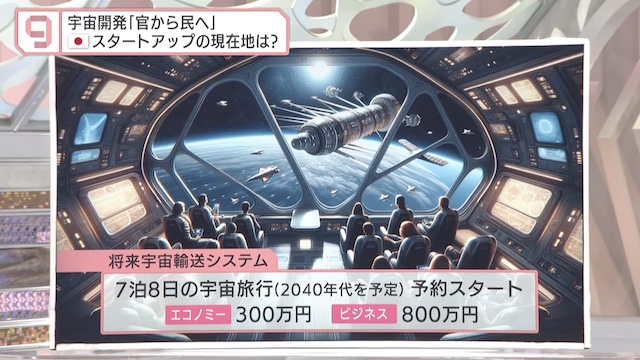
Hatada's company plans 7-night space trips starting in 2040.
"People often say the price is too low, but to achieve this, we need to cut current space costs by two digits, which is challenging."
The key to reducing costs is effective reuse. SpaceX's reusable rockets are used 10-20 times, but the aim is for over 1,000 reuses, like aircraft.
How is Japan developing spaceports for space tourism?
"Japan's geography offers great potential for spaceports. If private companies lead, real estate developers and contractors can create tourism opportunities."
How does the public-to-private shift in space development look?
"NASA contracting services to private companies sparked a trend. Private involvement accelerates development."
How crucial is space as an industry?
"Space is becoming infrastructure, essential for society, like internet from satellites."
How does Hatada view Japan's space startups, which have increased to over 100?
"Japan's space startups have increased tenfold in six or seven years, but globally, we are still lagging. However, there is potential to catch up."
Source: テレ東BIZ