News On Japan

Top Women’s Shogi Player Raises Concerns Over Pregnancy Rules

OSAKA - The issue surrounding rules related to pregnancy and childbirth in professional shogi has drawn renewed attention, with leading female player Kana Fukuma expressing lingering concerns over newly proposed revisions despite acknowledging some progress.

Fukuma, who holds five major women’s titles, said during a press conference held on May 3rd that after carefully reviewing the contents of the final report by a review committee, “there are still some areas where concerns remain.”

At the center of the controversy was a rule set by the Japan Shogi Association stating that if any part of a title match overlapped with the period from six weeks before childbirth to eight weeks after, the player would be replaced.

Fukuma had previously lost a title by default after being unable to adjust her match schedule due to pregnancy-related health issues. Reflecting on that experience in December last year, she said, “I couldn’t even fully feel happy about what should have been a joyful pregnancy, and at the time it was unbearably painful.”

Based on that experience, Fukuma had called for a revision of the rules, including the introduction of a “provisional champion” system that would allow title holders to retain their status without forfeiting their titles.

In response, the association removed the rule requiring player replacement and, on April 30th, the review committee released its final recommendations. These included establishing a consultation service for pregnancy and childbirth-related matters and adjusting match schedules in principle until the start of the next tournament cycle.

However, as alternative measures in cases where scheduling adjustments are not possible, the committee did not adopt the provisional champion system requested by Fukuma. Instead, it presented three options, including granting seeded status in the following tournament cycle.

While offering a certain level of support for the revised proposals, Fukuma expressed concern that under the seeding system, players would still effectively lose their titles.

“My honest feeling is that there are still aspects where concerns cannot be fully dispelled,” Fukuma said. “I hope the rules will evolve in a way that does not make players hesitate between competing in shogi and wanting to have children.”

Fukuma said she intends to closely monitor both the final formulation of the rules and how they are implemented in practice going forward.

Source: KTV NEWS

News On Japan
POPULAR NEWS

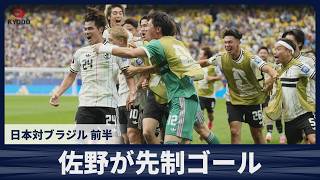
Japan’s World Cup campaign ended in the cruelest possible fashion on June 29, as Gabriel Martinelli scored in the fifth minute of stoppage time to give Brazil a 2-1 victory over the Samurai Blue in their knockout match in Houston. Japan had led in the first half and were still level at 1-1 in the final moments, but Martinelli’s late strike sent Brazil into the Round of 16 and eliminated Japan from the tournament.

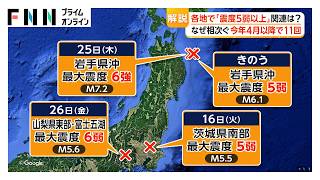
Strong earthquakes have continued to shake parts of Japan in recent weeks, with 11 temblors measuring lower 5 or above on the Japanese seismic intensity scale recorded across the country since April 2026.

A Kintetsu Railway train derailed inside Kyoto Station on the morning of June 29, forcing partial suspensions on the Kintetsu Kyoto Line for the rest of the day and causing long delays that hit commuters, students and tourists.

A section of stone wall at Hikone Castle, one of Japan’s few surviving original Edo-period castles and a National Treasure whose main keep remains intact more than 400 years after its construction, collapsed after heavy rain caused by Typhoons No. 7 and No. 8, Hikone city officials said.

Japan advanced to the knockout stage of the World Cup after a 1-1 draw with Sweden on June 25, finishing second in Group F and setting up a Round of 32 clash with Brazil in Houston.

MEDIA CHANNELS
         

MORE Sports NEWS

The Asian Games, opening on September 19, will be held without a traditional athletes village, with organizers instead planning to accommodate athletes and officials in container-style housing, a cruise ship and hotels across Nagoya and surrounding prefectures.

Japan advanced to the knockout stage of the World Cup after a 1-1 draw with Sweden on June 25, finishing second in Group F and setting up a Round of 32 clash with Brazil in Houston.

Japan will face Brazil in the Round of 32 at Houston Stadium at 2:00 a.m. Japan time on June 30, with Hajime Moriyasu’s side seeking the first knockout-stage victory in the country’s World Cup history against the five-time champions and one of the tournament’s most dangerous attacking teams.

In 2006, these teams met for the first time at the world’s biggest football tournament. Back then, you could bet on Brazil to win at odds of 1.28 and hardly worry about the outcome.

Japan delivered their strongest performance of the World Cup so far with a 4-0 victory over Tunisia in Monterrey on June 21, moving to four points in Group F and putting themselves in a strong position to reach the knockout stage ahead of their final group match against Sweden.

Japan's national soccer team arrived in Monterrey, Mexico, after holding a mostly closed training session near Nashville, Tennessee, on June 18 as it prepares for a key Group F match against Tunisia on June 20 local time, or June 21 in Japan, at Monterrey Stadium.

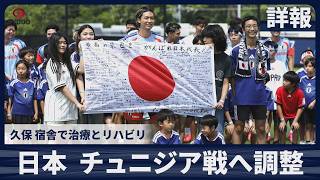
Japan's national team continued preparations on June 17 for its World Cup Group F match against Tunisia, holding a largely closed training session near Nashville, Tennessee, ahead of the June 20 fixture, which will be played on June 21 Japan time.

When Japan faces Tunisia at AT&T Stadium in Arlington, Texas, at 1 p.m. local time on June 20 (3 a.m. Japan time on June 21), the Samurai Blue will have an opportunity to take a major step toward the knockout stage of the 2026 FIFA World Cup.