News On Japan

North Korea missile eludes radar, posing challenge for Japan defense

TOKYO - Japan failed to accurately predict the trajectory of North Korea's most recent ballistic missile test on Thursday morning because it disappeared from radar after launch, as increasingly advanced missiles complicate defense efforts.

Japan's Ministry of Defense saw a risk that the missile, launched at around 7:22 a.m., would land in the vicinity of the northern main island of Hokkaido, based on Self-Defense Force radar and other information. The Cabinet Secretariat issued an alert for the island about 30 minutes after launch.

The alert was retracted after about 20 minutes, when it was determined that the missile would not land in the Hokkaido area. It did not fall within Japan's territory or exclusive economic zone.

At a subsequent press conference, Chief Cabinet Secretary Hirokazu Matsuno said the missile disappeared from radar immediately after it was detected.

The Defense Ministry usually announces a missile's altitude, flight distance, and point of impact within an hour or two of launch. As of 9:30 p.m. on Thursday, no such announcement had been made. ...continue reading

News On Japan
POPULAR NEWS

A section of wall plaster and part of a roof eave were found damaged at Himeji Castle, the UNESCO World Heritage site in Hyogo Prefecture, on June 4th, with officials investigating whether strong winds from Typhoon Jangmi (Typhoon No. 6) were responsible.

Typhoon Jangmi (Typhoon No. 6) swept across Japan on June 3rd, bringing record-breaking rainfall, widespread flooding, landslides, transport disruptions, and powerful winds, while prompting Tokyo's first-ever issuance of a Level 4 danger alert under the country's new weather warning system. The storm also exposed challenges surrounding evacuation behavior, as many residents chose not to leave their homes despite official warnings affecting more than 1.6 million people across the Tokyo metropolitan area.

A body discovered in a river in Tatsuno, Hyogo Prefecture, has been identified as 42-year-old Kenji Oyama, the suspect wanted nationwide in connection with the murder of a mother and daughter last month, police announced on June 4th.

As Typhoon Jangmi (Typhoon No. 6) struck Wakayama Prefecture on June 3rd, the storm became the first major test of Japan's newly introduced disaster weather warning system, revealing both the benefits of earlier evacuation calls and the challenges local authorities faced in helping residents understand and respond to the new alerts.

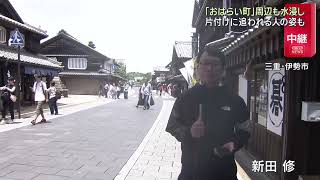
Flooding was reported around the popular tourist district of Oharai-machi in Ise City following the passage of Typhoon No. 6, with some businesses forced to clean up after floodwaters overflowed from a nearby river during the early hours of June 3rd.

MEDIA CHANNELS
         

MORE Politics NEWS

The Japanese government has presented estimates showing how long it would take to implement a reduction in Japan's consumption tax on food products, indicating that cutting the rate to either zero percent or 1 percent would require significant preparation time.

The Japanese government approved a supplementary budget proposal exceeding 3 trillion yen on June 3rd, including the creation of a new contingency reserve aimed at responding to developments in the Middle East and addressing rising energy prices.

The leader of the Democratic Party for the People, Yuichiro Tamaki, suggested on June 2nd that his party may oppose a bill drafted by the Liberal Democratic Party to establish a new criminal offense for desecrating the national flag, arguing that it could unduly restrict freedom of expression.

Japanese Prime Minister Sanae Takaichi held a telephone conversation with Iranian President Masoud Pezeshkian on June 1st, urging Iran to demonstrate maximum flexibility in its ongoing discussions with the United States and expressing hope that an agreement on the nuclear issue can be reached as soon as possible.

Defense Minister Shinjiro Koizumi strongly rejected accusations that Japan is embracing "new militarism," describing such claims as false while delivering a speech at a major regional security conference in Singapore on May 31st.

Defense Minister Shinji Koizumi met with U.S. Defense Secretary Pete Hegseth on May 30th while visiting Singapore for the Asian security forum known as the Shangri-La Dialogue, as the two sides discussed ways to further strengthen the Japan-U.S. alliance and expand defense cooperation.

Prime Minister Sanae Takaichi renewed her determination to resolve the long-standing abduction issue involving North Korea on May 30th, declaring her willingness to pursue a summit meeting with North Korean leader Kim Jong Un as families of the victims gathered in Tokyo to demand the return of their loved ones.

Japan's Defense Minister Shinji Koizumi held the first-ever trilateral meeting with his counterparts from Australia and New Zealand, where the three sides exchanged views on defense cooperation, including the potential export of the Maritime Self-Defense Force's latest frigate design.