OSAKA, Mar 02 (News On Japan) - As the number of foreign visitors to Japan continues to rise, two uniquely Japanese cultural phenomena — food replicas and capsule toys, known as gacha — are drawing growing attention as unexpected tourist attractions and potential new souvenir staples.
At “Gachagacha no Mori” in Umeda, around 2,400 capsule toy machines line the store, creating a dense forest of colorful plastic spheres. Roughly 70% of customers are women, mainly in their 20s to 40s, though the appeal now extends to a wide range of generations, including visitors in their 70s. The machines are almost constantly crowded.
While anime-related merchandise once dominated the market, food-themed capsule toys have recently surged in popularity. One sushi-themed series — now in its fourth edition — features hyper-realistic pieces of tuna and other toppings, some with a miniature sniper hidden inside the sushi. The blend of meticulous detail and playful absurdity has proven irresistible. Many foreign visitors can be seen walking through the aisles clutching photos on their smartphones, searching for specific items they discovered on social media.
Among the most sought-after items is the “Machibouke” series, small figurines designed to sit at the entrance of a home or in front of a television, often shaped like bread with tiny arms and legs. A visitor from Taiwan said she had toured several capsule toy shops in search of a particular piece after spotting it online. Store staff note that customers frequently present screenshots with explanations in English or Chinese, underscoring how widely these products are circulating overseas via SNS.
Originally fueled by Japan’s anime boom, capsule toys have since diversified into key holders, magnets and practical accessories used in daily life. According to a Nikkei report, the capsule toy industry is now in its fifth boom, with market size doubling over the past decade. Earlier waves date back more than 40 years, including the era of Kinnikuman erasers known as “Kinkeshi.” What began as children’s entertainment in supermarket toy sections has evolved into a full-fledged cultural market occupying prime retail locations in major cities.
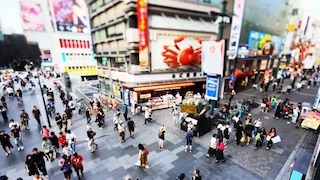
Meanwhile, authentic food replicas — long used by restaurants to display menu items — are also gaining traction among foreign visitors. At a specialty shop in Osaka’s Doguyasuji shopping street, shelves are filled with remarkably lifelike samples of sushi, ramen and desserts. Store staff say most customers are from overseas.
“It’s so cute. We saw it last night on our walk and came back today,” said one visitor from the United States. “In California, they don’t have this.”
The shop also offers hands-on workshops where participants create their own food replicas. The most popular option is a takoyaki coloring experience, fitting for Osaka. Participants paint realistic scorch marks onto the octopus balls using a sponge before adding sauce and aonori seaweed. The finished product can be made into a magnet or holder.
The session lasts about 40 minutes and costs from 2,980 yen, making it an accessible activity for tourists. Although no foreign participants were present during the interview, staff say several groups join without reservations each day, particularly Americans.
Participants often become deeply focused on perfecting the browning effect. Interestingly, staff observe that overseas visitors sometimes apply darker coloring across the entire surface, revealing subtle differences in aesthetic preference. After drying for a day, the initially chocolate-colored surface transforms into a realistic golden-brown finish.
The convergence of SNS exposure and surging inbound tourism appears to be accelerating global recognition of Japan’s food replica culture. What was once a niche domestic hobby has grown into a broader cultural export. With specialty stores opening in prime urban locations, capsule toys and food samples may soon establish themselves not just as a passing boom, but as enduring symbols of contemporary Japanese pop culture — and perhaps a new standard souvenir for visitors returning home.
Source: Television OSAKA NEWS