News On Japan

Nara's Deer Population Runs Wild

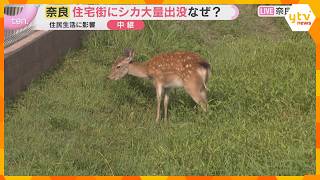
NARA - Large numbers of deer are appearing in residential neighborhoods around Nara, raising concerns over traffic accidents, crop damage and the spread of ticks and fleas as the animals move farther beyond Nara Park in search of food.

Deer have recently been seen grazing on grass, walking through private properties and crossing roads in quiet neighborhoods about 2 kilometers south of the park, where detached homes and apartment buildings line the streets.

Residents have become accustomed to the animals, but locals say both the number of deer and the frequency of sightings have increased. Some have also appeared near routes used by elementary school students.

Herds have been spotted near JR Nara Station, about 2 kilometers west of Nara Park, showing that the animals are moving into heavily developed parts of the city.

The deer population in Nara Park reached a record 1,465 last year. The increase has been partly attributed to excessive feeding linked to the growth in inbound tourism.

As the population grows, the park's grasslands are no longer providing enough food. Female deer are believed to be leaving the park with their young, while male deer, which naturally tend to move away from groups, may encounter them outside the park.

Experts believe some deer have established new territories and reproduced beyond the park, creating second- and third-generation populations that have never lived within its grounds. Reports suggest deer living outside the park can be more aggressive than those accustomed to visitors inside it.

Nara's deer are designated as a national natural monument, including wild animals outside Nara Park. Prefectural officials and members of deer protection organizations generally respond to reports by approaching herds from behind and driving them back toward the park.

However, reports have increased as deer appear in areas where they were rarely seen before. Officials also say some animals repeatedly leave the park even after being driven back.

The expansion of their habitat is already affecting transportation and agriculture. An express train on the Kintetsu Nara Line struck a deer near Shin-Omiya Station in April.

Farmers have also reported crops being eaten shortly before harvest, while household vegetable gardens have suffered damage.

There are also concerns that fleas and ticks carried by deer could spread beyond Nara Park and increase the risk of infectious disease. When agricultural damage occurs, authorities may impose population limits and cull animals.

Other prefectures are also struggling with rising deer populations. Deer numbers have increased in Osaka Prefecture, while excessive grazing in Shiga Prefecture has been linked to vegetation loss and a subsequent debris flow.

Experts say more precise population management is needed despite the financial cost, along with protective measures coordinated across prefectural borders rather than handled by Nara alone.

People who encounter deer are advised not to approach them, feed them or shout. Authorities are urging residents to observe the animals calmly while measures are developed to allow people and deer to coexist.

奈良公園外へシカ拡大 過去最多の個体数で住宅街にも出没

過去最多となったシカが餌不足を背景に奈良公園の外へ移動し、住宅街での目撃が相次ぎ、交通事故や農作物被害、ダニやノミの拡散への懸念が高まっている。

奈良鹿數量創新高 湧入住宅區引發憂慮

奈良鹿群因數量創下歷史新高及食物不足,逐漸離開奈良公園進入住宅區,引發交通事故、農作物受損以及跳蚤與蜱蟲擴散的擔憂。

Source: YOMIURI

News On Japan
POPULAR NEWS

Dangerous heat is expected across a wide area from western to eastern Japan today, prompting authorities to issue heatstroke warning alerts for 17 prefectures, the highest number so far this year.

Japan has become an unexpected base of operations for Russian intelligence agents since Moscow’s invasion of Ukraine, with spies allegedly using the country to procure and smuggle high-tech equipment and other goods to Russia, The New York Times reported on July 12.

Convenience store operators in Japan are strengthening safety measures as bear-related damage grows more serious, with Lawson expanding the use of bear repellent spray and considering drone-based remote monitoring.

Osaka’s Minami district, now entering another period of major change with the planned opening of the Naniwasuji Line, the redevelopment of Midosuji and improvements around Nankai Namba Station, has transformed from an area once described as "scary" and "dirty" into one of Japan’s leading tourist destinations.

A 10-ton hoko float was pulled through central Kyoto on July 12 in a trial run ahead of the Yamahoko Junko procession during the Gion Festival's early parade.

MEDIA CHANNELS
         

MORE Travel NEWS

Tokyo Disney Resort will raise the maximum price of its one-day tickets from October, with adult admission to Tokyo Disneyland and Tokyo DisneySea rising by as much as 1,500 yen to 12,400 yen on selected high-demand days.

Two typhoons are currently near Japan, with Typhoon No. 9, Bavi, over North China and Typhoon No. 11, Haishen, east of the Philippines, but only Bavi is expected to have any indirect impact on the country.

An abandoned concrete arch bridge deep in the forests of Kamishihoro in Hokkaido's Tokachi region is slowly being reclaimed by nature, its exposed reinforcing bars and weeds marking the passage of time.

Osaka’s Minami district, now entering another period of major change with the planned opening of the Naniwasuji Line, the redevelopment of Midosuji and improvements around Nankai Namba Station, has transformed from an area once described as "scary" and "dirty" into one of Japan’s leading tourist destinations.

A 10-ton hoko float was pulled through central Kyoto on July 12 in a trial run ahead of the Yamahoko Junko procession during the Gion Festival's early parade.

Large Typhoon No. 9 (Bavi) was over central China at 9 p.m. on July 12 and moving north-northwest, with the storm expected to weaken as it continues northwest before turning into an extratropical cyclone that will merge with the rainy season front and bring rain mainly to areas along the Sea of Japan coast.

A wave of bear sightings across Japan has forced the cancellation of traditional summer events, while one animal entered a home and came within inches of a sleeping resident's face.

Large numbers of deer are appearing in residential neighborhoods around Nara, raising concerns over traffic accidents, crop damage and the spread of ticks and fleas as the animals move farther beyond Nara Park in search of food.