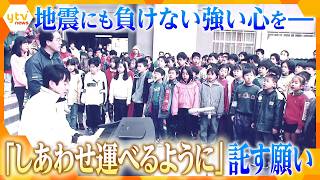
KOBE - Makoto Usui, the composer of "Shiawase Hakoberu Yoni," a song written in the aftermath of the 1995 Great Hanshin-Awaji Earthquake that has become a symbol of hope for disaster survivors across Japan and overseas, died in July at the age of 65, leaving behind a musical legacy that his former students are determined to carry forward.
A special video featuring previously unreleased footage of Usui's life, his lesser-known compositions and the inspiration behind his most celebrated work was screened at a memorial gathering held at Kobe Shinwa University on September 26, offering a retrospective of a teacher whose music has supported disaster-stricken communities for more than three decades.
"Shiawase Hakoberu Yoni," meaning "May We Bring Happiness," begins with a call to maintain a strong spirit in the face of earthquakes. Written shortly after the disaster devastated Kobe in January 1995, the song became so deeply embedded in the city's culture that virtually every elementary school student came to know it. It was officially designated a Kobe city song in 2021 and has since been translated into more than 10 languages, spreading to disaster-affected communities throughout Japan and abroad.
Usui, whose own home was completely destroyed in the earthquake, wrote the song in just 10 minutes after seeing television footage of the devastated city approximately two weeks after the disaster. He later recalled being overwhelmed by the sight of Kobe, saying it felt as though the entire city had disappeared. The words came to him so suddenly that he hurriedly scribbled them onto a piece of paper.
The song was first performed publicly about a month after the earthquake at the elementary school where Usui was teaching. Evacuees sheltering at the school and volunteers helping with relief efforts gathered to listen as the children sang.
At the time, tensions had arisen between the school's educational responsibilities and its role as an evacuation shelter, with teachers struggling to accommodate displaced residents while continuing to care for their students. Those who heard the performance recalled how the song helped ease the strained atmosphere and brought comfort to people facing an uncertain future.
Usui's musical journey had begun decades earlier. He reportedly composed his first song at the age of four, although his debut was hardly auspicious. The song made fun of a friend, prompting a severe scolding from his mother.
By high school, Usui hoped to become a singer-songwriter. After graduating from university, however, he reluctantly entered the teaching profession as an elementary school teacher. His attitude changed when he discovered how much children enjoyed his music, inspiring him to compose songs for school events, classroom activities and special occasions.
Over his lifetime, he wrote more than 400 songs, many inspired by his experiences in the classroom. Among them were songs welcoming visitors to school and humorous compositions about fellow teachers.
In one recording, Usui introduced a song about a teacher named Morita, whom he jokingly described as possibly the most frightening teacher in the world. He explained that despite Morita's intimidating reputation, children loved him because he was so entertaining.
Other compositions reflected the more emotional side of his teaching career. During his final lesson as an elementary school teacher, Usui performed a song dedicated to his graduating students, encouraging them to carry music with them throughout their lives.
He told the children that although they might forget their teacher's face as they grew older, he hoped they would always remember the joy of music. Whatever happiness or sadness awaited them, he wanted them to consider music a lifelong companion, sing their favorite songs and become kind people who could show compassion toward others.
The memorial footage also revealed another composition connected to the Great Hanshin-Awaji Earthquake, written the year after the disaster.
At an elementary school in Kobe, a fifth-grade student named Yamauchi had died in the earthquake. When the surviving classmates advanced to sixth grade, they adopted the phrase "Our Hearts Are Always 46 Strong" as a way of remembering their friend and maintaining the unity of their original class.
Usui transformed their feelings into a choral composition, expressing the children's determination to continue living together in spirit as the full group of 46 classmates.
One former student recalled being deeply grateful to Usui for transforming their overwhelming grief into something positive. Now that the former student's own children have reached a similar age, the experience has taken on new meaning, strengthening a determination to pass the story on to the next generation.
Usui's commitment to disaster survivors extended far beyond his hometown. Following the 2004 Niigata Chuetsu Earthquake, he sent musical scores and other materials to affected communities, encouraging children to use music as a source of strength during the recovery.
His song also reached Fukushima after the March 2011 Great East Japan Earthquake and tsunami, where it inspired the formation of a choir.
Among its members was a young woman named Ten Murata, who lost three relatives in the tsunami and struggled for years with feelings of guilt and resentment over what had happened.
Through singing the song, reflecting on the meaning of its lyrics and interacting with survivors of the Kobe earthquake, Murata gradually began to reassess her experiences.
She recalled being consumed not only by grief but also by anger toward everything surrounding the disaster. At one point, she had even thought that if her mother had not come to collect her, she might have died alongside her relatives.
Murata said she hoped that by the 20th anniversary of the Fukushima disaster, she would be able to confront those feelings and eventually come to accept herself.
She credited both the song and the choir with helping her through an extremely difficult period, saying that without either of them, she might no longer have been alive.
The experience illustrated the wider impact of Usui's music, which evolved from a song expressing Kobe's determination to recover into a means of connecting survivors of different disasters across generations and national borders.
Following his retirement as an elementary school teacher, Usui continued his educational work at university, where he trained future teachers and passed on his belief in the importance of music in children's development.
Former students and fellow educators remember him as a teacher whose compositions grew directly from his relationships with children. Usui himself reflected that his teaching career had been supported, guided and enriched by the clear voices and innocent eyes of his students.
His commitment to music remained closely connected to his experiences of the earthquake and his determination to ensure that those who died would not be forgotten.
Thirty-one years after the Great Hanshin-Awaji Earthquake, "Shiawase Hakoberu Yoni" continues to be performed at schools, memorial gatherings and disaster recovery events. Its lyrics encourage people to maintain strong hearts, remember those who lost their lives, cherish each day and work together to rebuild devastated communities.
In one of his final recorded reflections, Usui expressed his confidence that the song would endure beyond his lifetime. He hoped that children throughout Japan would continue singing it, even if the country were fortunate enough to experience no further disasters.
For Usui, the song's purpose was not limited to encouraging those directly affected by earthquakes. He wanted future generations to remember people who had lost their lives, including those who desperately wanted to survive but could not, and to maintain a sense of compassion toward communities that had experienced tragedy.
His former students are now carrying that message forward, preserving both his music and the spirit of solidarity that inspired it.
The special memorial video, screened at Kobe Shinwa University on September 26, brings together previously unreleased scenes, classroom performances, interviews and recordings of Usui's compositions, documenting how a song written in just 10 minutes became a lasting symbol of resilience for disaster survivors in Japan and around the world.
Source: YOMIURI