TOKYO - Prime Minister Sanae Takaichi is entering the autumn political season under growing pressure to show that her government can manage relations with Washington and Beijing while keeping Japan’s economic policy on a credible path after the Bank of Japan’s latest rate hike.
Takaichi’s recent meeting with U.S. President Donald Trump in New York placed Japan’s alliance with the United States back at the center of her political agenda. The talks, held on the sidelines of the U.N. General Assembly, came shortly before Trump’s meeting with Chinese President Xi Jinping, giving Takaichi an opportunity to convey Japan’s concerns directly before Washington and Beijing moved into their own summit diplomacy.
Takaichi described her exchange with Trump as timely, saying Japan considers it important that U.S.-China relations contribute to the stability of the international community, including Japan. She said the two leaders exchanged views on issues concerning China, though she did not give a detailed account of the discussion.
Japan and other U.S. allies in Asia have been watching Trump’s China diplomacy closely, particularly for any sign that Washington might soften its position on Taiwan, trade restrictions or technology controls in exchange for economic concessions from Beijing. For Tokyo, the concern is not only what the United States says publicly, but what understandings might be reached in leader-to-leader diplomacy.
Takaichi used the New York meeting to emphasize the strength of the Japan-U.S. alliance at a time when Asia’s security environment is becoming more severe. She also highlighted cooperation in artificial intelligence, semiconductors and critical minerals, areas where Japan wants to be seen not only as a security ally but also as an economic-security partner.
That message was reinforced by separate trilateral talks among the foreign ministers of Japan, the United States and South Korea. The three sides reaffirmed U.S. defense commitments to Japan and South Korea, stressed peace and stability across the Taiwan Strait and announced a new trilateral consultation mechanism on economic security and critical technologies.
For Takaichi, the trilateral language is politically useful. It shows that Japan is not acting alone in responding to China’s military pressure, economic coercion and technology competition. It also gives her a broader framework for explaining why economic security, defense modernization and supply-chain resilience have become central to her government’s agenda.
China remains the most sensitive issue. Takaichi has already angered Beijing by saying that a Taiwan contingency could amount to a survival-threatening situation for Japan. Beijing has also taken measures affecting Japanese exports of chip-related materials and other strategic goods, reinforcing the government’s argument that Japan must reduce vulnerability in key supply chains.
The political challenge is that economic security has costs. Measures to strengthen semiconductor supply chains, critical-mineral access and defense technology require public investment and cooperation with industry. They also risk further friction with China, which remains a major market and supply-chain partner for Japanese companies.
Trump’s approach adds another uncertainty. He praised Takaichi during their meeting and signaled warmth toward Japan, but his foreign policy remains highly transactional. Tokyo needs U.S. support on deterrence, Taiwan, technology and currency stability, while also preparing for possible U.S. demands on defense spending, investment, trade and market access.
That makes the Trump-Takaichi meeting both a diplomatic success and a source of risk. It gave Takaichi a visible stage to show alliance coordination, but the real test will come from the results of Trump’s negotiations with Xi and whether Japan’s interests remain protected in any U.S.-China arrangement.
At home, the Bank of Japan’s latest rate hike has become the main economic-policy test. The BOJ raised its policy rate to 1.25% on September 17, the highest level in 31 years, signaling a shift from encouraging inflation toward preventing it from overshooting. Governor Kazuo Ueda indicated that further hikes remain possible, depending on inflation, wages and financial conditions.
The rate hike helps Takaichi in one respect. Higher rates can support the yen and ease import-driven inflation, especially for food, energy and raw materials. That matters politically because rising prices have been one of the clearest sources of public frustration with the government.
But the same rate hike makes the government’s fiscal agenda harder to manage. Higher interest rates increase debt-servicing costs and put more pressure on bond markets. They also raise the cost of borrowing for companies and households, which could complicate Takaichi’s efforts to present her administration as both pro-growth and supportive of household budgets.
The yen’s reaction remains important. The BOJ’s move was expected to support the currency, but markets have been sensitive to dissent within the central bank and to uncertainty over how quickly further hikes will come. If the yen weakens again, import inflation could return as a major political problem. If the yen strengthens sharply, exporters and investors exposed to carry-trade unwinds could face pressure.
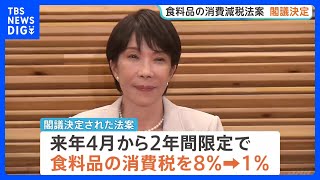
Takaichi’s food-tax cut is the other central domestic issue. The government plans to reduce the consumption tax on food from 8% to 1% for two years from April 2027, while also providing payments that would effectively eliminate the remaining 1% burden for households during the period.
The policy is politically simple: food prices are high, and the government wants voters to see direct relief. But the fiscal explanation remains incomplete. The tax cut is expected to create a large revenue shortfall, and Finance Minister Satsuki Katayama has said the government will not rely on deficit-financing bonds.
That leaves the reshuffled cabinet with a difficult task before the autumn Diet session. It must explain how the food-tax cut will be funded, how long the measure will remain temporary, and how the government will protect social-security financing while also containing bond-market concern.
The cabinet reshuffle earlier this month was designed to give Takaichi a more stable platform for that fight. She retained key ministers including Katayama, Foreign Minister Toshimitsu Motegi, Defense Minister Shinjiro Koizumi, Chief Cabinet Secretary Minoru Kihara and economic policy minister Minoru Kiuchi. The reshuffle replaced a number of other ministers, but the core economic and security team remained in place.
That continuity was intended to reassure markets and foreign partners. Katayama remains central to fiscal and currency policy. Motegi is responsible for managing diplomacy with the United States, China and South Korea. Koizumi remains in charge of defense modernization. Kihara continues to manage the government’s daily message. Kiuchi is tied to growth, digital policy, artificial intelligence and startups.
The risk is that continuity also means responsibility. If the government fails to explain the tax-cut funding plan, if bond yields rise further, or if China policy creates new economic friction, the retained ministers will be judged as part of the existing problem rather than a fresh solution.
Takaichi has also retained much of the Liberal Democratic Party’s senior leadership, including Vice President Taro Aso, Secretary-General Shunichi Suzuki, Policy Research Council Chairman Takayuki Kobayashi and Election Strategy Committee Chairman Yasutoshi Nishimura. Former Diet Affairs Committee Chairman Hiroshi Kajiyama became General Council chairman, while Masafumi Murai took over the Diet affairs role.
The party lineup suggests that Takaichi is prioritizing internal stability before next year’s LDP presidential race. But there were signs of tension in the Upper House leadership process, where Hiroshi Ishii was not reappointed and Hiroshi Aoki was chosen as his successor after several lawmakers reportedly declined the post.
That matters because Diet management will become more difficult in the coming months. Opposition parties are likely to press the government on tax-cut funding, BOJ independence, bond yields, defense spending and the costs of economic-security policy. Any visible LDP disunity could make those attacks more effective.
Defense policy remains another major theme. Japan’s latest defense white paper has already drawn controversy by framing military buildup not only as a security necessity but also as part of economic growth and industrial development. The government is emphasizing drones, unmanned systems, missile capabilities, cyber defense and advanced surveillance.
Takaichi can argue that the regional environment justifies the buildup. China’s military activity, North Korea’s missile development and Russia’s presence near Japan all support the case for stronger deterrence. But the fiscal question remains. Defense expansion, food-tax relief and strategic industrial investment all require funding at a time when borrowing costs are rising.
Takaichi is therefore trying to hold together several difficult messages at once. She is telling Washington that Japan is a reliable alliance partner. She is telling Beijing that Japan will not retreat on security. She is telling households that food-price relief is coming. She is telling markets that fiscal discipline remains intact. She is telling the BOJ that monetary policy remains independent, while also needing higher rates not to undermine growth.
The central question is whether those messages can coexist. If the Trump-Xi summit preserves U.S. support for Taiwan Strait stability, if the yen remains stable after the BOJ rate hike, and if Katayama can present a credible funding plan for the food-tax cut, Takaichi may enter the autumn Diet session with renewed control of the agenda. If U.S.-China diplomacy unsettles allies, if bond yields rise or if the tax-cut plan looks underfunded, multiple pressures could converge on the administration just as the Diet session begins.
What To Watch Next
The outcome and interpretation of Trump’s talks with Xi will be the main foreign-policy focus, especially on Taiwan, technology controls, rare earths, tariffs and agricultural or industrial trade commitments.
Japan will watch whether Washington maintains strong language on Taiwan Strait stability after Takaichi’s meeting with Trump and the U.S.-Japan-South Korea foreign ministers’ statement.
The yen’s movement after the BOJ’s rate hike will remain a key political signal. A renewed decline would revive inflation concerns, while a sharp rally could pressure exporters and carry trades.
The government still needs to explain how it will fund the food-tax cut without deficit-financing bonds.
Bond yields should be watched closely as higher interest rates raise the cost of Takaichi’s tax, defense and investment agenda.
The autumn Diet session will test whether the cabinet reshuffle and LDP executive lineup can deliver stable parliamentary management.
China’s reaction to U.S.-Japan coordination and Taiwan-related language could affect trade, supply chains and economic-security policy.
Opposition parties are likely to frame the government’s challenge as a credibility test: whether Takaichi can promise household relief, stronger defense and fiscal discipline at the same time.