News On Japan

Japan Approves Bill to Cut Food Consumption Tax to 1%

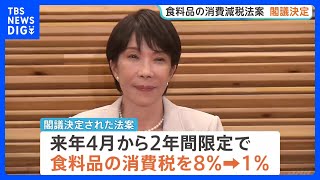
TOKYO - The Japanese government has approved a bill to reduce the consumption tax on food from 8% to 1% for two years beginning in April 2027, while pledging to finance the measure without issuing deficit-covering government bonds, although it has yet to specify how it will cover the estimated 10 trillion yen cost.

The legislation, approved by the Cabinet, would temporarily lower the tax rate on food purchases to 1% and provide an additional benefit equivalent to the remaining 1 percentage point to working people on low and middle incomes.

Finance Minister Satsuki Katayama defended the proposal as the most effective means of delivering relief to households, emphasizing both the adequacy and speed of the support. "We believe this is the best approach in terms of providing sufficient and timely assistance, and we intend to explain these points carefully during parliamentary deliberations," she said.

The two-year reduction is expected to create a revenue shortfall of approximately 10 trillion yen, raising questions about how the government will reconcile household relief with its fiscal commitments. Katayama stressed that the administration would not rely on deficit-covering government bonds, citing the importance of maintaining market confidence, but postponed the announcement of specific funding arrangements.

Attention has consequently turned to government spending programs, particularly subsidies and publicly funded reserves, as potential sources of financing for the tax reduction.

A ministerial meeting was held to accelerate a review of subsidies and government funds, with Katayama criticizing the progress made by ministries and agencies in identifying unnecessary or ineffective expenditures.

"To be frank, I do not believe the reviews conducted so far have been sufficient at all. We need to step up our efforts," Katayama said.

The finance minister expressed dissatisfaction with the assessments undertaken by individual government departments and called for stricter scrutiny of whether subsidies deliver benefits commensurate with their costs.

The government also intends to examine the extensive reserves accumulated in public funds, which are projected to total approximately 7 trillion yen by the end of the next fiscal year. Funds that have remained unused for extended periods would be returned to the national treasury, freeing resources that could potentially help finance the proposed tax relief.

Preferential tax arrangements for small and medium-sized businesses and other beneficiaries will also face a comprehensive reassessment. Katayama said these provisions would be reviewed from scratch, with measures demonstrating limited policy effectiveness to be abolished.

The initiative signals a broader effort to redirect existing fiscal resources toward household support rather than expand borrowing. However, the government has not yet established how much revenue can realistically be recovered through subsidy reductions, the return of unused funds and the elimination of preferential tax measures.

With the proposed food tax reduction scheduled to begin in April 2027, the administration faces the challenge of identifying sufficient savings to support the two-year program while preserving investor confidence in Japan's public finances.

Source: TBS

News On Japan
POPULAR NEWS

A fire broke out at a factory handling waste plastic in Nara City on October 13, sending thick black smoke into the air and prompting the dispatch of 12 fire engines after firefighters received an emergency call shortly before 3:30 p.m. from a factory representative reporting smoke rising from inside the building, with all workers safely evacuated and no injuries reported.

Prime Minister Sanae Takaichi delivered an unusually harsh rebuke of Agriculture, Forestry and Fisheries Minister Kazuo Yana on October 13, describing his claims about cutting road budgets in areas that failed to support him as "inappropriate" and "really lame," while signaling that she would reconsider whether he should remain in office as opposition lawmakers intensified their demands for his dismissal.

Japan is facing a growing wave of cyberattacks as advances in artificial intelligence remove the language barrier that once made Japanese companies difficult targets for overseas hackers, with more than 68 million personal records potentially exposed in a series of security incidents over the past two weeks.

Japan is expected to experience a warmer-than-normal winter as the El Nino phenomenon currently affecting the Pacific Ocean has reached its strongest level on record, with the Japan Meteorological Agency announcing on October 10th that unusually high sea surface temperatures are likely to persist through the coming winter months.

The Otsu Festival, one of Shiga Prefecture's three major traditional festivals, was held in Otsu City on October 11th, featuring a procession of 13 elaborately decorated floats carrying traditional mechanical puppets through the streets, following the festival's addition to UNESCO's Intangible Cultural Heritage list in December last year.

MEDIA CHANNELS
         

MORE Politics NEWS

Japan's Agriculture Minister Kazuo Yana is facing mounting pressure to resign over remarks suggesting that government funding was reduced for municipalities that failed to support him in an election, with opposition parties considering a censure motion that could disrupt parliamentary deliberations on a consumption tax reduction bill.

The government’s plan to cut the consumption tax on food is turning into a broader fight over public spending, ministerial accountability and whether Prime Minister Sanae Takaichi can keep her autumn Diet agenda focused on household relief rather than political damage control.

The Japanese government has approved a bill to reduce the consumption tax on food from 8% to 1% for two years beginning in April 2027, while pledging to finance the measure without issuing deficit-covering government bonds, although it has yet to specify how it will cover the estimated 10 trillion yen cost.

Japan's Maritime Self-Defense Force unveiled its latest submarine, the Shogei, at a launch ceremony in Kobe on October 8, featuring improved detection capabilities and quieter onboard systems following construction at a cost of approximately 80.5 billion yen.

The US military suspended activities by all forces stationed in Okinawa for 48 hours from noon on October 7, an unusual measure following the arrest of a US Marine in connection with a robbery and murder case that has renewed scrutiny of crimes involving American service members.

Prime Minister Sanae Takaichi defended her plan to cut the consumption tax on food and provide support payments to workers in the House of Representatives on October 7, seeking to keep household relief at the center of her autumn Diet agenda while markets continue to test the government’s fiscal credibility.

Prime Minister Sanae Takaichi has delivered her second policy speech since taking office, placing economic growth and investment at the center of her agenda as her government enters a critical period dominated by plans to cut the consumption tax on food, controversy surrounding Agriculture Minister Yanagi, and a packed diplomatic schedule in November.

Prime Minister Sanae Takaichi has strongly condemned the arrest of a U.S. Marine on suspicion of robbery and murder at a hotel in Naha, Okinawa, describing the crime as "extremely brutal and vicious," while Foreign Minister Toshimitsu Motegi summoned U.S. Ambassador to Japan George Glass to lodge a formal protest and demand measures to prevent similar incidents.