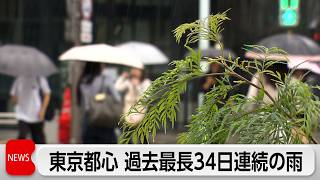


TOKYO - Rain fell again in central Tokyo on September 28, extending the capital's unusually long wet spell to 33 consecutive days and matching the longest run on record, while persistent rainfall is beginning to disrupt autumn tourism, fall foliage and the harvest of seasonal crops.
Large raindrops pounded roads around JR Shibuya Station on the morning of September 28 as the prolonged autumn rains continued.
The unusual wet spell has been driven by a succession of typhoons affecting Japan and an increasingly active autumn rain front.
The impact is already being felt at popular autumn tourist destinations.
Around Lake Chuzenji in Nikko, Tochigi Prefecture, intermittent rain left the normally busy sightseeing area unusually quiet, with relatively few visitors.
Local businesses said the prolonged bad weather was hurting sales. "It's just rain, rain and more rain. There's nothing we can do about it. Sales are down," an employee at Aizuya Shokudo said.
There are also concerns that the wet weather could affect the timing of the autumn foliage season. The employee said the fall colors could arrive much later than last year, potentially shifting the peak viewing period from October into November.
At Ryuzu Falls, one of Nikko's best-known autumn foliage spots, the prolonged rain has increased the volume of water cascading over the stepped rocks, sending heavy spray into the air.
Some leaves around the falls have begun to show the first hints of autumn color. In a typical year, the area would be expected to reach peak foliage in about two weeks.
Junko Murone of Ryuzu no Chaya said the lack of sunshine could have some impact on the leaves. "With weather like this, I think the reduced sunshine will have some effect. I just hope we still get good autumn colors," she said.
The long spell of rain is also threatening one of Japan's seasonal foods: freshly harvested soba.
At buckwheat fields operated by the Sanbuichi Soba Association in Hokuto, Yamanashi Prefecture, rainwater remains pooled across fields where buckwheat seeds would normally be approaching harvest in early October.
Toshinori Sakamoto of the association said standing water was preventing seeds from germinating. "As you can see, rainwater has accumulated in this field. When it gets like this, the buckwheat won't germinate," he said.
In a normal year, the fields would be covered with small white buckwheat flowers, but growth in 2026 has varied sharply from field to field.
Sakamoto said some fields will produce nothing at all. "There will be absolutely no harvest here. This year in particular, the rain kept coming, and the seeds were submerged in water at the time they should have germinated, so they rotted," he said.
Buckwheat prefers dry conditions and is particularly vulnerable to excess water. The prolonged rain has caused problems including root rot, while some of the buckwheat that did grow has produced unusually small grains.
The association expects its harvest to be about 40% lower than in a normal year.
Sakamoto said he has harvested buckwheat from the same fields every year for about 17 years but has never seen so many plants fail to produce grain.
Concerns are also spreading to soba restaurants in Nagano Prefecture as the new-season buckwheat period approaches.
Toru Kobayashi of Sobakura Miyata said new soba is due to arrive from October, but lower production and rising prices are expected to push procurement costs higher. "New soba starts in October, but production is low and prices are rising sharply. We've already been told that purchase prices will increase again from October," he said.
Restaurants are also facing higher costs for shrimp, vegetables and other ingredients used in tempura, a common accompaniment to soba.
Uncertainty remains over how long the record-breaking autumn rains will continue.
In addition to Typhoon No. 26 approaching Japan, a new tropical depression has formed over waters south of the country. It remains unclear whether the system will strengthen into a typhoon, but its development and movement will require close monitoring.
Source: FNN