

TOKYO - Japan's government is facing growing pressure from opposition lawmakers to clarify who will qualify for a new financial support program and how much they will receive, as deliberations on legislation to reduce the consumption tax on food and introduce payments for low- and middle-income earners enter their final stages in the House of Representatives.
The proposed measures, scheduled to take effect in April 2027, are intended to ease the burden of rising prices, taxes and social insurance contributions on working households. However, the government has yet to establish specific eligibility criteria or payment amounts, prompting criticism that lawmakers are being asked to approve legislation without knowing how it will affect taxpayers.
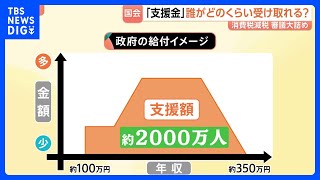
Under the government's preliminary estimates, the support payments would cover approximately 20 million people earning between 1 million and 3.5 million yen annually. Payment amounts would vary according to income, with the aim of increasing disposable earnings for lower-income workers.
The proposed upper income threshold of 3.5 million yen has become a central point of contention, with opposition lawmakers questioning whether people earning above that amount should be excluded from a program explicitly intended to help middle-income households.
Kazuyoshi Akaba, chairman of Komeito's tax research commission, challenged the government's definition of middle income during parliamentary deliberations.
"If 3.5 million yen is considered middle income, does that mean someone earning around 4 million yen is a high-income earner? I've never heard of anything like that," Akaba said.
Finance Minister Satsuki Katayama acknowledged the criticism, saying that middle-income earnings are generally higher than 3.5 million yen.
"The government takes that point very seriously," Katayama said, suggesting that the administration may consider expanding the range of people eligible for the payments in response to opposition demands.
Akaba also criticized the government for failing to provide concrete figures ahead of the planned vote, arguing that the absence of essential information was preventing meaningful parliamentary scrutiny.
"We can't continue debating this. This isn't some kind of quiz," Akaba said. He warned that proceeding to a vote without disclosing the relevant figures would leave serious consequences for the legislative process and the responsibilities of elected representatives.
Katayama has repeatedly explained that reducing the financial burden on middle-income earners, who have struggled with taxes, social insurance premiums and rising living costs, is among the administration's most important priorities.
The financial support program is being considered alongside a temporary reduction in the consumption tax on food, scheduled to begin in April 2027.
The government plans to lower the consumption tax on food and beverages from the current reduced rate of 8% to 1% for two years, combining the tax reduction with income-linked payments to effectively eliminate the tax burden on qualifying food purchases.
The support payments are intended to provide additional relief for working households, particularly those whose disposable income has been squeezed by higher living costs and mandatory contributions. However, uncertainty over the eligibility thresholds and actual payment amounts has raised questions about how effectively the measures will reach middle-income earners.
The issue comes as retailers prepare for changes in household spending following the planned tax reduction.
Major department stores unveiled their traditional New Year lucky bags on November 4, including packages featuring regional specialties from Kumamoto, which experienced an earthquake in July, and assortments of more than 20 types of seafood from across Japan.
Other offerings include experiential packages allowing customers to take part in sheep shearing and related activities, reflecting 2027's designation as the Year of the Sheep.
Takashimaya has introduced a lucky bag containing a month's supply of frozen food together with a household freezer, priced at 20,270 yen in recognition of the coming year.
A department store representative explained that the company expects demand for prepared meals and frozen food stockpiling to increase following the consumption tax reduction on food, prompting the development of the combined freezer and frozen food package.
Meanwhile, political negotiations over the tax reduction and support payment legislation are approaching a critical stage.
The ruling Liberal Democratic Party and the Democratic Reform Association agreed to hold further committee deliberations on Friday, November 6, with Prime Minister Sanae Takaichi in attendance.
The ruling bloc hopes to put the legislation to a committee vote that day and submit it urgently to a plenary session of the House of Representatives for approval before the end of the day.
However, opposition lawmakers have not committed to supporting the proposed timetable, insisting that the government must provide sufficiently clear explanations before a vote can proceed.
Yuichi Goto, chairman of the Democratic Reform Association's Diet affairs committee, said the opposition would determine whether a vote could take place after hearing the prime minister's responses.
"We will look at the answers given on Friday and decide at that point whether we can proceed with a vote," Goto said.
With the planned April 2027 introduction approaching, the government faces mounting pressure to establish a clearer definition of middle-income households and explain precisely how the new financial support system will distribute assistance to millions of workers.
Source: TBS