News On Japan

Japan to ease requirements on foreign interns transfering jobs

TOKYO - As Japan's labor maket tightens, and foreign technical interns effectively become valuable human resources, the government announced a plan on Wednesday to revise the training system to allow more job flexibility.

Approximately 350,000 interns in Japan work in various fields such as agriculture, fishing, and food processing under the Technical Intern Training System.

However, various problems have arisen, including the inability to "transfer to a job other than the same type of job."

Many people leave the workplace because they are unable to transfer when there are problems in the workplace, such as power harassment or violence. According to Japan's Immigration Bureau, approximately 9,000 technical intern trainees went missing in the past year.

Under the government's announced plan to revise the system, restrictions on transfers will be relaxed, allowing workers to transfer for any reason if they meet certain conditions, such as after one year of employment.

An expert government panel plans to submit a final report on the matter by the end of the year.

News On Japan
POPULAR NEWS

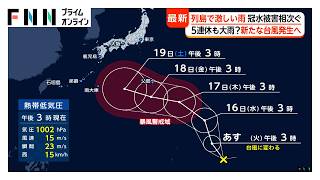
A tropical depression south of Japan is expected to develop into a typhoon on September 15 and could affect Okinawa during Silver Week, raising concerns over travel and tourism as Japan prepares for its first five-day Silver Week holiday in 11 years.

Climbers who get into trouble on Mount Fuji during the official closed season could be charged for rescue by disaster-prevention helicopters under new safety measures being considered by Yamanashi Prefecture.

Genta Koja, a former deputy mayor of Naha who accepts the relocation of the U.S. Marine Corps Air Station Futenma to Henoko in Nago, won the Okinawa gubernatorial election on September 13, defeating incumbent Governor Denny Tamaki and bringing an end to 12 years of prefectural administrations committed to blocking the project.

Roads around the Fushimi Otesuji Shopping Street in Kyoto's Fushimi Ward were flooded on the evening of September 13 after water began gushing from a nearby road, forcing authorities to close part of the street to traffic.

China will sharply raise visa fees for Japanese nationals entering the country from September 14, with the cost of a single-entry visa increasing to 16,750 yen, about 7.4 times the current level.

MEDIA CHANNELS
         

MORE Education NEWS

Elementary school students in Fukuoka got a hands-on lesson in the importance of taxes on September 11, lifting a 10-kilogram replica of 100 million yen as part of a class designed to show how public money supports society.

Raccoons are increasingly appearing in urban areas of Japan, including residential neighborhoods near Shin-Osaka Station, raising concerns over disease, attacks on people and agricultural damage that reached about 700 million yen nationwide last year.

Japanese 15-year-olds spend an average of 2.3 hours browsing social media during their weekday free time, the shortest amount among 24 countries surveyed, according to data from the Organization for Economic Cooperation and Development.

Renovation work has begun at a hospital in Izumisano, Osaka Prefecture, as the city prepares to introduce a baby hatch for parents unable to raise their children and a confidential birth system that allows pregnant women to give birth without publicly disclosing their identities.

A disaster prevention experiment has shown how quickly a rain-soaked slope can collapse once visible cracks appear, highlighting the need for people in landslide-prone areas to evacuate before conditions become critical as the risk of disasters remains elevated through early next week.

Nearly 60% of Japanese high school students consider learning about different cultures "very important," the highest proportion among Japan, the United States, China and South Korea, according to a survey released by the National Institution for Youth Education.

The number of elderly people in Japan with no relatives to rely on is projected to rise to 4.48 million by 2050, or roughly one in nine seniors, prompting the government to create a new system under revised social welfare laws to support people with daily needs, hospitalization and arrangements after death.

Japan's education ministry unveiled a draft of its new national curriculum guidelines on August 31, placing stronger information education for the AI era and greater flexibility in allocating classroom hours among the central pillars of the major overhaul carried out roughly once every decade.