

News On Japan

Japan's Salons Shave Costs with 'Haircut Monster'

TOKYO, Sep 12 (News On Japan) - Hair salon bankruptcies in Japan are on the rise, with 139 cases recorded between January and August 2024, a significant increase from previous years. Factors such as rising competition, material costs, and labor expenses are contributing to this surge. Despite these challenges, some salons are finding ways to thrive by adopting cost-effective strategies.

One standout example is Chokipeta, a chain with 72 locations across the Kanto and Kansai regions. Known for its low-cost haircuts priced at 1,430 yen, Chokipeta has managed to maintain its popularity by placing stores in convenient locations like supermarkets and shopping centers, allowing customers to get a haircut while running errands. This approach has proven successful, drawing in a steady stream of customers.

To keep prices low and improve efficiency, Chokipeta has implemented creative solutions, such as using automatic shampoo machines to handle part of the process, freeing up staff to attend to other clients. Customers are also asked to dry their own hair after a shampoo, further reducing salon workload without compromising service quality. By streamlining operations, Chokipeta is able to increase customer turnover while easing the workload on their staff, making it easier to recruit new employees.

Meanwhile, DIY haircuts are gaining popularity, with more people opting to cut their own hair between salon visits. Feather Safety Razor Co. has capitalized on this trend with the success of its "Haircut Monster" bang trimmer, selling over 200,000 units since its launch two years ago. This product allows individuals to easily trim their bangs and maintain a natural look, catering to those who prefer to manage their own hair at home.

Source: TBS

News On Japan
POPULAR NEWS

A fire that scorched the exterior wall of a company operated by a Pakistani national was discovered in Ebetsu, Hokkaido, on March 1st, just one day after a mosque located about 400 meters away caught fire, prompting police to investigate the possibility that the two incidents may be connected.

Police plan to arrest a Japanese doctor in his 60s who lives in the United States and is suspected of spraying an oil-like liquid at Naritasan Shinshoji Temple in Chiba Prefecture in 2015, with the suspect expected to arrive in Japan as early as March 4th, investigators said.

The Ministry of Land, Infrastructure, Transport and Tourism has announced plans to draw up guidelines for the introduction of a so-called dual pricing system that differentiates between foreign visitors and local residents.

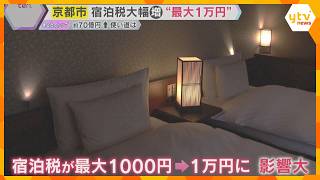
Kyoto City significantly raised its lodging tax from March 1st, increasing the maximum charge per person per night from 1,000 yen to as much as 10,000 yen, in a move aimed at tackling overtourism and funding the preservation of cultural assets, even as questions remain about its impact on visitors and the local economy.

A former emergency responder and foreign tourists worked together to rescue a woman in her 80s who was trapped inside an overturned light vehicle in Hakuba Village, Nagano Prefecture.

MEDIA CHANNELS
         

MORE Business NEWS

A Tokyo-based investment firm that had planned to take over the closed zoo North Safari Sapporo in Minami Ward, Sapporo, and develop a new zoological park has decided to scrap the plan as of March 3rd.

PayPay’s market capitalization is expected to exceed 2 trillion yen as the company prepares for a listing on the U.S. Nasdaq exchange.

All Nippon Airways held a press conference to announce a change in leadership, with Executive Vice President Hisaichi Hirasawa set to assume the role of president on April 1st, stating that sweeping reforms to the airline’s struggling domestic operations are urgently needed as profitability continues to deteriorate.

As price hikes spread from fast food to daily necessities and households grapple with rising living costs, the steady depreciation of the yen has emerged as a central driver of inflation, with multiple indicators showing that the currency’s purchasing power has fallen to roughly one-third of its mid-1990s peak, underscoring how three decades of economic stagnation, prolonged monetary easing and renewed fiscal expansion have left Japan far more vulnerable to imported inflation than other major economies.

An AI startup that emerged almost overnight, Akari had long been known only to insiders due to its limited media exposure, but after receiving investment from Mitsubishi Electric at the end of January and seeing its corporate valuation surge past 100 billion yen, the Tokyo-born venture has rapidly positioned itself as a leading unicorn candidate in Japan’s AI sector.

Mizuho Financial Group has decided on a policy to improve operational efficiency through the use of artificial intelligence, aiming to reduce administrative work equivalent to as many as 5,000 employees over the next decade.

Honda announced on February 26th that it will introduce a new model of its SUV, the CR-V, with prices starting at 5,122,700 yen.

The Japan Fair Trade Commission has conducted an on-site inspection of Microsoft’s Japanese subsidiary on suspicion of violating the Antimonopoly Act by potentially restricting the use of rival services.