News On Japan

Rare Look Inside Japan's Underground Gravity Wave Observatory

GIFU - The KAGRA gravitational-wave research facility in Kamioka, Hida, Gifu Prefecture, was opened to the public on June 20 for the first special viewing in nine years, giving 200 visitors a rare chance to tour the underground observatory with Nobel laureate Takaaki Kajita.

"I hear this is the first special opening in nine years. I think it will be an extremely valuable opportunity," Kajita said.

KAGRA is an observatory designed to detect gravitational waves, ripples that travel through space when objects move. The University of Tokyo's Institute for Cosmic Ray Research and other institutions use the facility to study large-scale cosmic phenomena, including black holes and supernova explosions.

During the June 20 opening, members of the public joined Kajita, who won the Nobel Prize in Physics, and other researchers for a tour of the observation equipment built in an underground space about 200 meters below the surface. The facility has a total length of 3 kilometers.

Participants listened as researchers explained how gravitational waves are observed and how the underground facility is used to investigate major changes in the universe.

日本の地下重力波観測施設を特別公開

岐阜県飛騨市神岡町にある重力波観測研究施設「KAGRA」が6月20日、9年ぶりに一般向けに特別公開され、参加者200人がノーベル物理学賞受賞者の梶田隆章さんとともに、地下観測施設を見学する貴重な機会を得ました。

日本地下重力波观测设施罕见开放

位于岐阜县飞騨市神冈町的重力波观测研究设施“KAGRA”于6月20日时隔9年再次向公众特别开放,200名参观者与诺贝尔物理学奖得主梶田隆章一同参观了这座地下观测设施,获得了一次难得的机会。

Source: Nagoya TV News
News On Japan
POPULAR NEWS

Dangerous heat is expected across a wide area from western to eastern Japan today, prompting authorities to issue heatstroke warning alerts for 17 prefectures, the highest number so far this year.

Japan has become an unexpected base of operations for Russian intelligence agents since Moscow’s invasion of Ukraine, with spies allegedly using the country to procure and smuggle high-tech equipment and other goods to Russia, The New York Times reported on July 12.

Convenience store operators in Japan are strengthening safety measures as bear-related damage grows more serious, with Lawson expanding the use of bear repellent spray and considering drone-based remote monitoring.

Osaka’s Minami district, now entering another period of major change with the planned opening of the Naniwasuji Line, the redevelopment of Midosuji and improvements around Nankai Namba Station, has transformed from an area once described as "scary" and "dirty" into one of Japan’s leading tourist destinations.

A 10-ton hoko float was pulled through central Kyoto on July 12 in a trial run ahead of the Yamahoko Junko procession during the Gion Festival's early parade.

MEDIA CHANNELS
         

MORE Sci-Tech NEWS

Fires involving lithium-ion batteries, including those used in mobile battery packs, are occurring at a record pace in Japan this year, with 179 incidents reported by the end of May, according to the Tokyo Fire Department.

JAXA successfully landed a small experimental vehicle for a reusable rocket on July 11, marking a step toward technology that could increase the frequency of space launches while helping reduce costs.

Japan is facing renewed questions over how to secure electricity while dealing with mounting nuclear waste, as power demand is expected to rise with the spread of generative AI and the government considers replacing as many as five nuclear reactors by the 2040s.

JAXA's Hayabusa2 probe made its closest approach to the asteroid Torifune on July 5, passing at high speed about 800 meters from the asteroid's center while conducting a flyby survey to examine its shape and surface materials.

A fossil discovered in Osaka has led to Japan’s first finding of its kind, raising the possibility that a giant marine predator believed to have swum in the seas around the Kansai region about 70 million years ago was a previously unknown species.

Researchers around the world are turning their attention to mitochondria, the energy-producing structures inside cells, as new discoveries suggest they may hold important clues to slowing aging, preventing disease and extending healthy life.

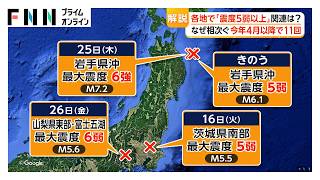
Strong earthquakes have continued to shake parts of Japan in recent weeks, with 11 temblors measuring lower 5 or above on the Japanese seismic intensity scale recorded across the country since April 2026.

Japan is set to begin its first clinical trial of xenotransplantation involving the transplant of pig kidneys into human patients, in a step that could open a new option for people with kidney failure.