News On Japan

Japan to Launch First Pig Kidney Transplant Trial in Humans

TOKYO - Japan is set to begin its first clinical trial of xenotransplantation involving the transplant of pig kidneys into human patients, in a step that could open a new option for people with kidney failure.

PorMedTec, a venture company launched from Meiji University, has been conducting research on xenotransplantation using kidneys from genetically modified pigs designed to reduce the risk of rejection after transplant.

The clinical trial aimed at practical application is expected to be carried out at Hokkaido University Hospital and Shonan Kamakura General Hospital in Kanagawa Prefecture, possibly as early as 2028.

In the United States, where research in the field is more advanced, there have been reports of a patient who received a transplant using the technology and remained free from the need for dialysis for nine months.

The company said it hopes to provide xenotransplantation as an option in response to the severe shortage of organ transplant donors.

The trial will be closely watched as a potential step toward practical use of the technology in Japan.

Source: FNN

News On Japan
POPULAR NEWS

Dangerous heat is expected across a wide area from western to eastern Japan today, prompting authorities to issue heatstroke warning alerts for 17 prefectures, the highest number so far this year.

Japan has become an unexpected base of operations for Russian intelligence agents since Moscow’s invasion of Ukraine, with spies allegedly using the country to procure and smuggle high-tech equipment and other goods to Russia, The New York Times reported on July 12.

Convenience store operators in Japan are strengthening safety measures as bear-related damage grows more serious, with Lawson expanding the use of bear repellent spray and considering drone-based remote monitoring.

Osaka’s Minami district, now entering another period of major change with the planned opening of the Naniwasuji Line, the redevelopment of Midosuji and improvements around Nankai Namba Station, has transformed from an area once described as "scary" and "dirty" into one of Japan’s leading tourist destinations.

A 10-ton hoko float was pulled through central Kyoto on July 12 in a trial run ahead of the Yamahoko Junko procession during the Gion Festival's early parade.

MEDIA CHANNELS
         

MORE Sci-Tech NEWS

Fires involving lithium-ion batteries, including those used in mobile battery packs, are occurring at a record pace in Japan this year, with 179 incidents reported by the end of May, according to the Tokyo Fire Department.

JAXA successfully landed a small experimental vehicle for a reusable rocket on July 11, marking a step toward technology that could increase the frequency of space launches while helping reduce costs.

Japan is facing renewed questions over how to secure electricity while dealing with mounting nuclear waste, as power demand is expected to rise with the spread of generative AI and the government considers replacing as many as five nuclear reactors by the 2040s.

JAXA's Hayabusa2 probe made its closest approach to the asteroid Torifune on July 5, passing at high speed about 800 meters from the asteroid's center while conducting a flyby survey to examine its shape and surface materials.

A fossil discovered in Osaka has led to Japan’s first finding of its kind, raising the possibility that a giant marine predator believed to have swum in the seas around the Kansai region about 70 million years ago was a previously unknown species.

Researchers around the world are turning their attention to mitochondria, the energy-producing structures inside cells, as new discoveries suggest they may hold important clues to slowing aging, preventing disease and extending healthy life.

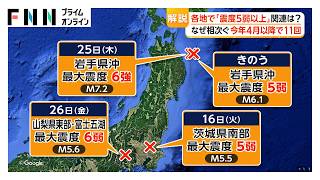
Strong earthquakes have continued to shake parts of Japan in recent weeks, with 11 temblors measuring lower 5 or above on the Japanese seismic intensity scale recorded across the country since April 2026.

Japan is set to begin its first clinical trial of xenotransplantation involving the transplant of pig kidneys into human patients, in a step that could open a new option for people with kidney failure.