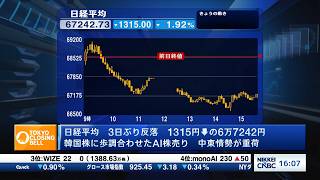
TOKYO - Tokyo stocks fell for a third straight session on July 8 as selling in semiconductor and AI-related shares continued, while rising Japanese government bond yields, Middle East tensions and concern over the Bank of Japan’s policy independence added pressure to the broader market.
The Nikkei 225 Stock Average closed at 66,819.05, down 1,437.91 points, or 2.11%, according to Nikkei Indexes. The index briefly turned positive during the session but lost momentum in the afternoon and finished at the day’s low, falling below 67,000 for the first time in nearly a month.
The broader TOPIX fell 55.83 points, or 1.37%, to 4,006.43. Prime Market trading value reached 9.0778 trillion yen, with 846 stocks falling and 670 rising, showing that selling had spread beyond the Nikkei’s technology-heavy names.
Nikkei CNBC and NQN framed the session as a continuation of the correction triggered by the “Samsung shock,” with investors still reducing exposure to AI and semiconductor shares after sharp losses in South Korean chip stocks earlier in the week. The market also faced ETF distribution-related selling pressure, which traders had expected around July 8 and July 10.
The key feature of the session was Japan’s tight correlation with South Korea. NQN said the Nikkei and South Korea’s Kospi were moving almost in parallel, with overseas speculative investors treating the two markets as part of the same semiconductor and AI trade. When the Kospi steadied, the Nikkei recovered; when the Kospi weakened again, Tokyo shares also turned lower.
That correlation is changing how investors read the Tokyo market. In earlier phases of the rally, traders often looked first to Wall Street for direction. But in the current phase, South Korean chip shares are becoming just as important because Samsung Electronics, SK Hynix and Kioxia are being watched as indicators of the memory and AI cycle.
The chart picture also deteriorated. The Nikkei broke below its 25-day moving average for a second straight session, making it harder to dismiss the decline as a false breakdown. Market participants said the failure to recover quickly suggested the index may have entered a correction phase after its AI-led surge.
The close was especially weak. Nikkei CNBC noted that the index dropped about 350 points from around 3:25 p.m. into the closing auction, suggesting that investors moved to cut positions rather than carry risk overnight. The finish at the day’s low reinforced the impression that dip-buying is losing force.
Kioxia Holdings remained one of the most closely watched stocks after its sharp fall on July 7 left it near the 70,000 yen level seen by market participants as a key defensive line. The stock has become a symbol of the broader AI trade, and whether it can hold that level will be watched closely for clues about investor sentiment.
The changing leadership of the Japanese market was another focus. Kioxia’s surge had raised talk of a new AI-centered market structure, while Toyota had briefly shown signs of renewed buying after a long period of weakness. But as Kioxia lost momentum and Toyota’s rebound struggled to gain force, Mitsubishi UFJ Financial Group and other banks emerged as the clearest beneficiaries of the current rate environment.
Mitsubishi UFJ remained relatively firm after touching a listing high earlier in the week, supported by higher interest rates and expectations for stronger profitability. If Mitsubishi UFJ’s market capitalization overtakes Toyota’s, it would mark a symbolic shift in Japanese equities from the old export-manufacturing leadership toward financial stocks benefiting from the end of ultra-low rates.
Japan’s bond market remained the day’s central policy focus. The 10-year Japanese government bond yield rose as high as 2.870%, near its highest level in about 30 years, as investors reacted to concerns over fiscal expansion and language in the government’s economic blueprint that appeared to call for monetary policy to align with the administration’s growth agenda. Reuters reported that the government is considering revising the wording to emphasize the BOJ’s role in achieving stable inflation.
The concern is that if the BOJ is seen as moving too slowly because of political pressure, inflation expectations and yen weakness could become harder to control. At the same time, faster rate increases could push borrowing costs even higher, raising pressure on government finances, households and companies.
Banks remained relatively better supported because higher interest rates can improve lending margins and investment income. Megabanks, regional banks and Japan Post Bank have benefited from the rate backdrop, although the broader equity selloff limited the sector’s ability to offset weakness in technology shares.
The yen stayed near historically weak levels, keeping currency markets alert for possible intervention. A weak yen supports exporters and companies with large overseas earnings, but it also raises import costs for food, fuel and raw materials. That pressure is feeding into household budgets and complicating the BOJ’s task as Japan moves further from its deflation-era policy framework.
Corporate movers reflected the market’s rotation and its limits. Toyota remained a focus as investors looked for signs of recovery in lagging large-cap exporters, but higher oil prices and uncertainty over global sales made the rebound harder to sustain. Mitsubishi UFJ and other banks stayed firm on rising-rate expectations, while semiconductor and electronic component shares continued to struggle.
JR Tokai fell despite progress on the Linear Chuo Shinkansen project after Shizuoka Prefecture signaled approval for preparatory work. Although the development was positive for the project’s timeline, investors focused on the risk that construction delays, rising material costs and higher labor expenses could hurt profitability.
INPEX gained as oil prices rebounded on renewed uncertainty over Iran. Higher crude prices support energy producers, but they are a negative for Japan’s broader economy because the country depends heavily on imported fuel. Reuters reported that oil prices surged after U.S. President Donald Trump said an interim Iran deal was “over,” adding to market anxiety.
TV Tokyo’s business coverage has continued to focus on how inflation, wages, energy costs and asset prices are affecting households. The combination of rising wages and persistent price pressure is becoming a central issue for policymakers as they try to support growth without allowing inflation expectations to become unstable.
The global backdrop also weighed on sentiment. U.S. stocks fell overnight, high-tech shares weakened, oil rose on Middle East risk and investors remained cautious about AI valuations after the Samsung-led selloff in South Korea. The dollar also strengthened as investors sought safety, adding another layer of pressure for the yen.
The main points to watch next are whether the Nikkei can hold the mid-66,000 range, whether Kioxia stays above the 70,000 yen defensive line, whether ETF distribution-related selling fades after July 10, whether the 10-year JGB yield moves closer to 3%, and whether revised government language on BOJ policy can calm the bond market.
For Tokyo investors, July 8 showed that the correction is no longer only about semiconductor profit-taking. The market is now balancing four pressures at once: fading momentum in the AI trade, unusually tight linkage with South Korean chip shares, a yen near historic lows, and rising long-term interest rates that are forcing a reassessment of Japan’s equity rally.
Source: CNBC