
News On Japan

School Absence in Japan Climbs to Nearly 300,000; One Girl's Story

TOKYO - School absenteeism among Japanese elementary and middle school students has surged to approximately 300,000, with many students struggling to return after long holidays like Golden Week. In this context, a sixth-grade girl who overcame school absence shared her story.
School Absence in Japan Climbs to Nearly 300,000; One Girl's Story

As Golden Week draws to a close, many parents worry about their children falling into school absenteeism, especially during the transition from long holidays. In the 2022 academic year, the number of elementary and middle school students experiencing absenteeism increased by 50,000 to approximately 300,000, the highest number on record.

A sixth-grade girl living in Tokyo experienced school absence during her third term in the fourth grade. She recounted how she felt attacked and afraid after being criticized by a male classmate. This experience led to her becoming reluctant to attend school.

The girl's class was divided over classroom management, and the boys directed their frustration toward her. Her mother explained that her daughter was shocked when she was singled out during class.

Despite efforts by the school to address the issue through increased access to counselors, the girl’s mother found that getting her daughter to attend school was difficult when she was adamant about not going.

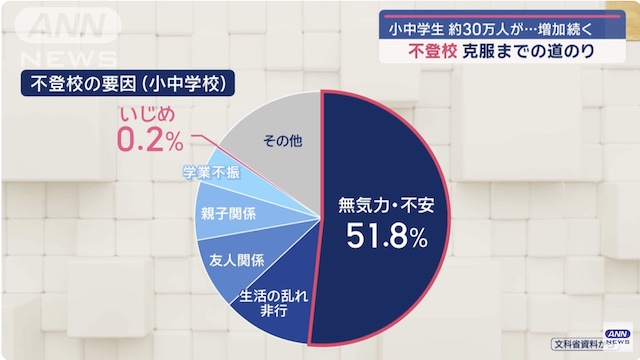
According to data from the Ministry of Education, Culture, Sports, Science and Technology, the leading cause of school absence is "lack of motivation or anxiety," accounting for over 50% of cases, while "bullying" constitutes only 0.2%.

The girl's journey to recovery began when her mother came across an organization called "Sudachi," which aims to guide students back to school within three weeks through parental involvement.

Sudachi's representative, Ryotaro Ogawa, emphasized the importance of focusing on the family rather than the school. The organization promotes limiting digital usage within the household and encouraging family activities, which led to improved communication and strengthened parent-child relationships.

The girl ultimately returned to school two months after her initial absence, shortly after her mother sought Sudachi's help. Now, the girl views school in a new light and appreciates it more than before.

Source: ANN

News On Japan
POPULAR NEWS

A prolonged eruption at Sakurajima on June 7th blanketed parts of Kagoshima City in volcanic ash, turning roads gray and prompting long lines of vehicles seeking car washes after a plume of smoke rose 1,300 meters above the crater.

A powerful earthquake struck off Mindanao Island in the southern Philippines at 8:38 a.m. (Japan time) on June 8th, generating tsunami waves across parts of the Pacific, causing building collapses and casualties near the epicenter, and prompting the Japan Meteorological Agency to issue tsunami advisories along a wide stretch of Japan's Pacific coastline before lifting all of them at 4:50 p.m.

A clinic director and a former Peruvian staff member have been referred to prosecutors after the man allegedly performed medical procedures without a license, including an external cephalic version—a procedure used to manually turn a baby into the correct position before birth—at an obstetrics and gynecology clinic in Fukuoka City, raising concerns about patient safety and oversight in maternity care.

A large bear was captured on security camera footage running through a shopping arcade in central Utsunomiya, Tochigi Prefecture, in the early hours of June 7th, as authorities stepped up warnings following a series of bear sightings across the city.

Japan's Meteorological Agency announced on June 7th that the rainy season is believed to have begun in the Tokai and Kanto-Koshin regions, marking the seasonal shift to wetter weather across a broad area of the country.

MEDIA CHANNELS
         

MORE Education NEWS

Birthrates in neighboring Kyoto and Shiga prefectures have moved in opposite directions, with experts pointing to housing costs, commuting convenience, and stable employment as key factors shaping where young families choose to live.

A panel exhibition held in Sapporo this year has reignited debate over what many experts and Ainu activists describe as a new form of discrimination—one that denies the Indigenous status of the Ainu people and seeks to reinterpret the history of discrimination they endured in Japan.

Elementary school students across Japan took part in the National Elementary School Toothbrushing Event on June 5th, with children at approximately 6,000 schools learning proper brushing techniques and oral hygiene practices under the guidance of dental hygienists.

Japan's total fertility rate, which represents the average number of children a woman is expected to have during her lifetime, fell to a record low of 1.14 in 2025, underscoring the country's deepening demographic challenges.

As Japan's shrinking youth population continues to reshape the education sector, a girls' high school in Kyoto has announced plans to become coeducational beginning next academic year.

Heart of the Country” is the story of Shinichi Yasutomo, the extraordinary principal of a rural elementary school in Kanayama, central Hokkaido, Northern Japan. Yasutomo is a man driven by his vision for learning and his passion for educating the heart as well as the mind. (TRNGL)

An Indonesian bus driver working in Tokyo says language barriers and differences in communication styles remain among the biggest challenges facing foreign workers in Japan, highlighting the importance of support from employers and colleagues as the country increasingly relies on overseas labor.

Japan will begin rolling out a major overhaul of its disaster weather information system from the afternoon of May 28th, reorganizing warnings and advisories to make it easier for residents to understand when they should evacuate.