Mar 25, 2026 (News On Japan) - Italian furniture exports to Japan have grown steadily for over a decade, but this growth has not been driven by aggressive retail expansion.
Brands like Poltrona Frau and Porada have established a loyal, high-spending customer base in Tokyo, Osaka, and Kobe through minimal conventional advertising. This market presence speaks more to cultural compatibility than to commercial strategy.
The product category that sells best is seating. A good quality Italian sofa, whether a Cassina sectional system or a Minotti corner couch, consistently performs in a market where buyers prioritize material precision and formal restraint over visual impact. The reasons, according to designers and distributors operating in both countries, run deeper than aesthetics.
Two design cultures, one set of values
Japan and Italy share something that rarely makes it into press releases: an unusually deep relationship between maker and material. In both cultures, the craftsman's knowledge of wood, leather, or stone is inherited over generations and expressed through restraint rather than excess. The Italian concept of bella fattura (beautiful making) resonates in a country where the quality of a joinery detail or the finish of a lacquered surface carries the same weight it does in Brianza or the Veneto.
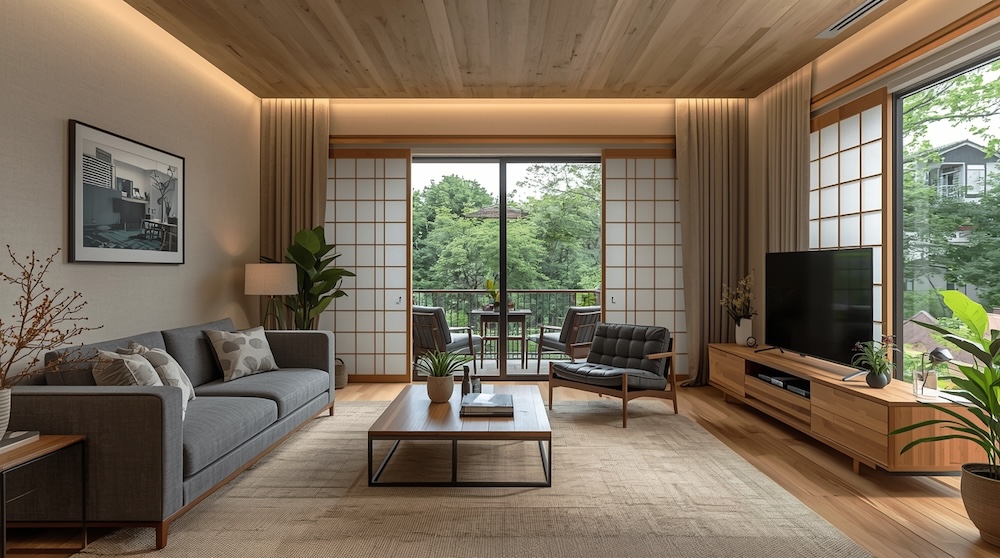
There are structural factors too. Japanese domestic interiors, particularly in urban apartments, tend toward clarity and spatial economy. Furniture that commands attention through form rather than volume, that works in compact configurations without losing its identity, has a natural advantage. Brands like Flexform and Molteni&C, both known for integrated living systems that balance visual lightness with structural presence, found receptive ground precisely because their design logic already matched how educated Japanese buyers think about space.
Two Italian brands that read the Japanese market right
Cassina's story in Japan is the most documented. The brand has operated through Cassina ixc., its exclusive Japanese distributor, for over thirty years, with a flagship showroom in the Aoyama district in Tokyo that was renovated in 2023 to reflect the brand's updated visual identity.
Minotti has followed a different trajectory, one of careful geographic expansion into secondary Japanese cities. Indeed, the brand recently opened a showroom in K?be. Minotti's neutral palette and architectural proportions, attributes shaped over decades under the creative direction of Rodolfo Dordoni, translate with unusual ease into Japanese residential contexts, where the absence of visual noise is a design goal in itself.
When Italian designers look to the East
Perhaps the most telling evidence of how deep the Japan-Italy design dialogue runs is found not in showroom sales figures but in the products themselves. Several Italian manufacturers have commissioned pieces that engage directly with Japanese aesthetic traditions, not as superficial cultural borrowing, but as substantive design responses to specific references.
B&B Italia Tobi-Ishi Table, designed by British duo Barber & Osgerby, takes its name and concept from the smooth ornamental stones placed in traditional Zen gardens. The result is a table that reads simultaneously as a sculptural object and a functional piece, a balance the Japanese design vocabulary has long made its own.
Gervasoni Kasane outdoor collection, created by Tokyo-based studio Nendo, goes further still: kasane means "overlapping" in Japanese, and the entire form language of the collection (stacked disc elements, clay surface textures, the rhythmic accumulation of thin edges) translates a specific quality of Japanese material consciousness into furniture that works under open skies.
Cassina Hayama Console by Patricia Urquiola takes its cue from the haori, the short jacket worn over a kimono, translating its geometry into a lacquered storage piece.
Porada Atsuko Cabinet, designed by David Dolcini, was created specifically to mark the opening of the brand's new showroom in Atsugi (Kanagawa). Its walnut's dark tones evoke the volcanic lava that shaped Mount Fuji.
Even the Bonaldo Moon Side Table, designed by Gino Carollo, distills something distinctly Japanese in the way its wooden top appears suspended above its base, while the marble insert functions as a contrast element, a pause in the form.
A market defined by recognition, not persuasion
What these products share, and what explains the durability of Italian furniture's position in Japan, is that they do not require explanation; they succeed not because of promotional effort but because Japanese buyers with a trained eye recognize, in the material quality and formal resolution of Italian manufacturing, something that corresponds to their own criteria for what a well-made object should be. That recognition, when it occurs, generates a loyalty that is difficult to dislodge. Cassina has understood this for thirty years. The rest of the Italian design industry is catching up.