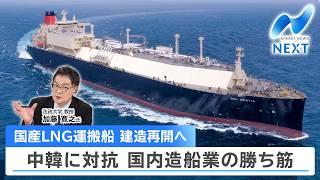

TOKYO - Imabari Shipbuilding, Kawasaki Heavy Industries, and Namura Shipbuilding are aiming to resume construction of liquefied natural gas carriers around 2035, as Japan’s shipbuilding industry looks for a path to recovery after losing much of the global market to lower-cost rivals in South Korea and China.
Japanese shipbuilders, once a dominant force in the global industry, have long struggled to compete with South Korean and Chinese companies that hold stronger cost competitiveness. LNG carriers, which require advanced technology and are central to global energy transport, are now seen as a possible area where Japan could rebuild its presence.
The move comes as the administration of Prime Minister Sanae Takaichi has listed shipbuilding as one of 17 key investment fields, raising expectations that the industry could receive greater policy support as part of Japan’s broader effort to strengthen strategically important sectors.
The program examines whether Japan’s shipbuilding industry can mount a comeback, inviting Hosei University Professor Hiroyuki Kato to discuss the strategies and challenges involved in reviving the sector.
Japan became the world’s leading shipbuilder in the postwar decades. From the 1950s through the 1970s, Japanese yards such as Mitsubishi Heavy Industries, IHI, Kawasaki Heavy Industries, Mitsui Engineering & Shipbuilding and Hitachi Zosen benefited from rapid industrialization, strong steel and machinery sectors, disciplined production methods, and surging global demand for oil tankers and bulk carriers. Japan’s competitive edge was not just low cost; it was reliability, quality control, efficient yard management and the ability to deliver large commercial ships at scale.
South Korea entered later but copied and surpassed much of Japan’s model. From the 1970s, Seoul treated shipbuilding as a strategic heavy industry, supporting the rise of Hyundai Heavy Industries, Daewoo Shipbuilding & Marine Engineering and Samsung Heavy Industries. Korean yards built huge dry docks, accepted large foreign orders aggressively, and used lower labor costs and massive scale to win tanker, container ship and offshore platform contracts. By the late 1990s and early 2000s, South Korea had overtaken Japan in many high-value segments, especially LNG carriers, very large container ships and offshore equipment.
Japan’s decline was gradual rather than sudden. Its shipyards remained technically strong, but they faced higher labor costs, a shrinking domestic workforce, a stronger yen at various points, fragmented yard structures, and less appetite for risky price competition. Japanese companies tended to focus on quality, long-term relationships with domestic shipowners and specialized vessels, while South Korea competed more aggressively for large international orders. Over time, Japan moved from global leader to third place.
China changed the rivalry again from the 2000s onward. Beijing treated shipbuilding as both an economic and strategic industry, pouring support into state-owned groups, port infrastructure, steel supply chains and large integrated yards. Chinese builders first captured lower-margin bulk carriers and tankers, then expanded into container ships and higher-spec vessels. China’s rise was rapid: UNCTAD says China, South Korea and Japan together accounted for about 95% of global shipbuilding output in 2023, with China delivering more than half of world capacity for the first time. South Korea contributed 28.2% and Japan 14.9%.
The current order is therefore China first, South Korea second and Japan third. OECD data for 2024, measured by compensated gross tons, put South Korea at about 27% of global completions, behind China, while Japan accounted for about 11%. China’s advance has continued to pressure other shipbuilding economies, with the OECD warning in June 2026 that Chinese scale is reshaping global competition and putting OECD shipbuilders under pressure.
The LNG carrier segment is especially important because it is one of the few areas where technology and track record still matter as much as price. South Korea dominates LNG carriers through membrane tank technology, construction experience and strong relationships with global energy and shipping companies. Japan once had a stronger LNG carrier presence, but lost ground as Korean yards became the default choice for many large orders. China has been trying to break into LNG carriers, but the segment remains more difficult than bulkers or tankers because vessels must safely carry gas at about minus 162 degrees Celsius; OECD noted that China’s LNG carrier market share had remained relatively low and that only Hudong-Zhonghua had large-scale experience at the time of its report.
That is why a Japanese move to restart domestic LNG carrier construction around 2035 matters. It is not simply about building more ships; it is about re-entering a strategic, high-value market where Japan may still have a possible opening through engineering quality, energy security policy, domestic shipping demand and alliance politics. Japan is unlikely to beat China on volume or South Korea on near-term LNG carrier scale, so its “winning path” would probably be selective: high-reliability ships, next-generation fuel systems, automation, dual-use maritime industrial capacity, and orders tied to Japanese energy companies and friendly-country supply chains.
Source: テレ東BIZ