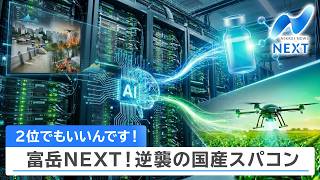
TOKYO - Japan's next-generation homegrown supercomputer, Fugaku NEXT, is being developed with a radically different strategy from its predecessors, abandoning the single-minded pursuit of the world's fastest calculation speed in favor of artificial intelligence capabilities expected to accelerate breakthroughs in fields ranging from drug development and batteries to disaster prevention and food production.
Japan's domestic supercomputers have traditionally been designed primarily for scientific and technological calculations, with raw processing speed serving as the principal benchmark of success. The K computer, jointly developed by RIKEN and Fujitsu, ranked first in the world for computing speed in 2011, while its successor, Fugaku, achieved the same position in 2020.
Japan's involvement in supercomputer development stretches back to the completion of its first such machine in 1977, and for many years the country was regarded as a leader in high-performance computing. However, Fugaku had fallen to seventh place in the global ranking as of November 2025, leaving Japan trailing systems developed by overseas companies, particularly those in the United States.
Fugaku NEXT, which is being developed with the aim of beginning operations around 2030, represents Japan's attempt to regain influence in the field, although its developers are no longer targeting the top position in computing speed alone.
The first major change is that the new system will seek to narrow the gap with global standards by cooperating with leading international technology companies rather than relying solely on domestic components. Although Fugaku NEXT will remain a Japanese supercomputer, plans have been announced for collaboration with U.S. chipmaker NVIDIA.
The project is also considering the adoption of a new type of memory being developed under the leadership of SoftBank and U.S. chipmaker Intel, in a market currently dominated by companies in South Korea and the United States.
The second major change is a shift toward an AI-centered design philosophy. In the transition from the K computer to Fugaku, developers placed priority on making highly accurate calculations at far greater speed, increasing computing performance by about 40 times.
For Fugaku NEXT, conventional computing performance is expected to increase by about six times, while AI performance is targeted to rise by as much as 300 times, making AI-driven calculation the central focus of the system.
Satoshi Matsuoka, director of the RIKEN Center for Computational Science, which is leading development of Fugaku NEXT, said AI could dramatically accelerate not only individual scientific disciplines but science as a whole, as well as manufacturing industries closely connected to research.
Under the conventional research process, scientists develop hypotheses, conduct experiments, verify results and repeat the cycle. Matsuoka said AI could dramatically speed up this process while also improving the quality of each individual result, enabling discoveries and innovations to emerge far more rapidly.
Such advances could lead to the development of new medicines and next-generation batteries, as well as improved disaster prevention measures, new approaches to agriculture and significant increases in food production, he said. The effects could also extend beyond science and industry into areas such as politics and law.
Matsuoka said Japan must pursue this future in cooperation with the rest of the world, noting that science operates on a global basis and that it is unrealistic for Japan to produce every necessary technology on its own.
Rather than a strictly "made in Japan" approach, Fugaku NEXT is based on the concept of "made with Japan," incorporating overseas technologies where necessary while ensuring that Japanese innovations also spread internationally.
Through this strategy, Japan is seeking not merely to sell hardware but to establish itself as a central player in the emerging field of AI for science, using Fugaku NEXT as a platform for discoveries and technologies that could transform society in the decades ahead.
Source: テレ東BIZ