Ask ten people for the best AI platform in 2026 and you get ten chatbot names. That is the wrong question.
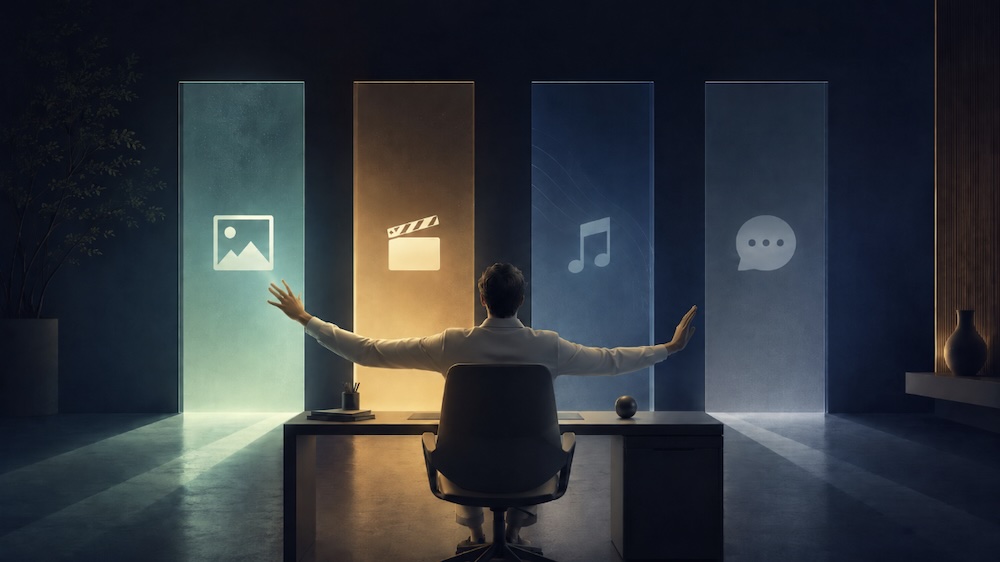
A chatbot writes your email. It does not edit a product photo, storyboard a 15-second ad, or score a jingle for your café's Instagram reel.
The real question is narrower and more useful: best at what, for whom? Once you ask it that way, the crowded field sorts itself out fast.
Japan's creator economy makes this concrete. A Tokyo indie studio, a Fukuoka e-commerce shop, a solo YouTuber in Osaka — none of them need "the smartest model." They need the platform that turns one idea into a finished asset with the fewest detours. Watch a Japanese small-business owner make a product listing and you see the pattern: the bottleneck is never the writing. It is the image that needs one clean edit, the 6-second clip for a TikTok ad, the background track that has to be royalty-clear. That is the lens I will use here.
What actually makes an AI platform "best" in 2026
Skip the leaderboard scores for a minute. Four criteria decide whether a platform earns a place in your week:
1. Task fit. Does it do the specific job — generate, edit, animate, compose — better than a general model bolted onto the task?
2. Control. Can you steer the output precisely (a region of an image, a shot length, a musical key) instead of re-rolling and praying?
3. Consistency. Does a character, style, or brand look survive across a whole set, not just one lucky frame?
4. Honest cost. What does the free tier actually give you, and where does the paywall start?
Notice what is missing: raw model IQ. In 2026 the frontier models are close enough that fit and control matter more than another point on a benchmark.
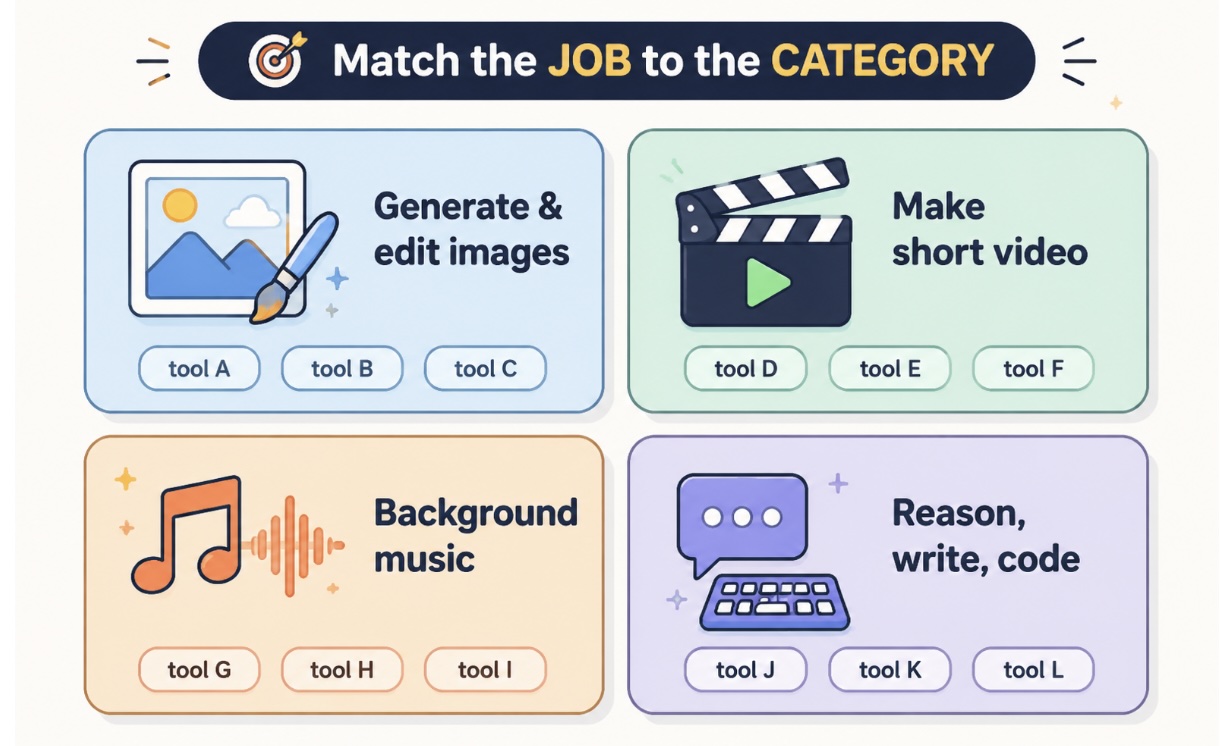
Here is the same idea as a cheat sheet:
| Your job | Category to reach for | Strong options in 2026 |
|---|---|---|
| ChatGPT, Gemini, Claude | General assistant | Reasoning, writing, code |
| Make or edit an image | Image platform | Nano Banana model, Midjourney, Firefly, creator platforms like Imagvio |
| Short video / social clip | Video generator | Veo, Sora, Runway, Kling |
| Background music / jingle | Music generator | Suno, Udio, bundled tiers |
General assistants: still the front door, not the whole house
For reasoning, drafting, and code, the big three are the safe defaults. OpenAI's ChatGPT (now on the GPT-5.2 line, with 5.3 rolling out) leads for general breadth. Google's Gemini is the pick if you live in Google Workspace and Search. Anthropic's Claude remains the favorite for long, careful writing and analysis.
Use one of these as your front door. But the moment your job turns visual or audio, a general assistant starts guessing, and guessing shows.
Image generation and editing: where task-specific wins
This is the category where specialized platforms pull clearly ahead. Google's image model, the one everyone knows by its old test codename "Nano Banana" (now shipping as Nano Banana 2, or Gemini 3.1 Flash Image, with 4K output and SynthID watermarking), reset expectations for prompt-based editing. It does not just make a new picture. It changes the one thing you asked for and leaves the rest of the scene intact.
The catch is that raw model access is not the same as a usable workflow. That gap is where creation platforms come in. Imagvio's AI Image Generator, for example, wraps that generation step in a creator-facing interface: you describe the shot, pick a style, and get variations without touching an API. One honest caveat: Imagvio is an independent platform and is not affiliated with Google. It gives you a place to use models like Nano Banana rather than being the model itself.
Editing is the sharper test. Regenerating an image is easy; changing a jacket color while keeping the model's face, pose, and lighting untouched is hard. A prompt-driven AI Image Editor handles exactly that kind of local edit — targeted changes that respect the rest of the composition, plus multi-image fusion when you need to blend a product into a new scene. For an e-commerce team producing 40 product variants a week, that consistency is the whole game. Midjourney, Adobe Firefly, and Leonardo AI compete hard in this space too; the right pick depends on whether you value editing precision, brand-safe training data, or community presets.
Video: the category that grew up in 2026
A year ago AI video was a novelty. Now Google Veo 3.1, OpenAI's Sora, Runway, and Kling 3.0 produce clips good enough for real social ads. The differentiators are shot control and length, not just fidelity.
If you already work inside an image platform, staying there for motion cuts friction — an integrated AI Video Generator lets you push a still you like into a short animated clip without exporting and re-uploading across four tools. For a small team, that one less handoff is worth more than a marginally sharper frame from a standalone giant. Test the free tier on a real 5-second shot before you commit; rendered video burns credits faster than images, and that is where costs hide.
Music: the quietly useful corner
Most "best AI" lists forget audio entirely. They shouldn't. Suno and Udio can score a background track for a video in the time it takes to write the brief. Rights and originality are still genuinely unsettled — read the license terms before anything goes commercial. For quick, royalty-clear background beds, a Free AI Music Generator tier is enough to test the idea; upgrade only once a track earns its place in a real project.
So which platform is best?
None of them. That is the honest answer, and it is the useful one.
- Reasoning, writing, code → ChatGPT, Gemini, or Claude.
- Images and precise editing → a specialized image platform. If you want models like Nano Banana inside one creator workflow, Imagvio AI is a reasonable place to start, with the usual free-tier caveat: the free credits are for evaluation, not production volume.
- Video → an integrated generator if you value fewer handoffs; a standalone giant if you need maximum fidelity.
- Music → Suno, Udio, or a bundled tier for background tracks.
The best AI platform in 2026 is not the smartest one. It is the one that turns your specific idea into a finished thing with the fewest steps in between. Pick by the job on your desk, not the headline on the leaderboard.
What is the one task you keep reaching for AI to do — and is your current tool actually built for it?