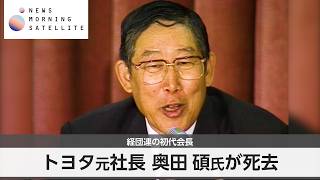


TOKYO - Hiroshi Okuda, a former president of Toyota Motor who helped lay the foundation for the automaker's emergence as one of the world's leading manufacturers, died of old age on August 8 at the age of 93.
Okuda served as Toyota's president from 1995 to 1999 and chairman from 1999 to 2006, leading the company during a period in which it strengthened its position in North America, Europe and Asia and established itself as one of the world's dominant automakers. Unlike many of Toyota's earlier leaders, he was not a member of the founding Toyoda family, making his rise to the top particularly notable within the company's history.
Born in Mie Prefecture on December 29, 1932, Okuda graduated from Hitotsubashi University in Tokyo in 1955 with a degree in business and joined Toyota the same year. He initially worked in accounting before building much of his career in international operations, eventually becoming deeply involved in Toyota's efforts to expand production and business overseas.
His long exposure to international business helped shape the strategy he pursued after becoming president in August 1995. Toyota at the time faced a strong yen, pressure on exports and a domestic market share that had fallen below 40%. Okuda treated the situation as a period requiring fundamental change, calling on employees to challenge established practices and identifying overseas expansion, new businesses, stronger product development and recovery of domestic market share as priorities.
That strategy accelerated Toyota's shift from a company heavily dependent on exports from Japan toward one producing vehicles closer to the markets where they were sold. During the second half of the 1990s, Toyota expanded manufacturing in the United States and established additional production operations in countries including France, Poland, India and China. Plants were established in Indiana and West Virginia in 1996, Toyota Kirloskar Motor was formed in India in 1997, a site for a French plant was selected in 1998, and Toyota Motor Manufacturing Poland was established in 1999.
The move toward localization was important both commercially and politically. Japanese automakers had faced years of trade friction, particularly with the United States, and Okuda repeatedly stressed that the automobile industry had become global rather than a collection of isolated national industries. He argued for greater international cooperation and harmonization while Toyota expanded production outside Japan.
One of the defining achievements of his presidency was Toyota's early commitment to hybrid technology. Development of what became the Prius had begun before Okuda took office, but his presidency proved a turning point in the project. Toyota engineers faced major technical difficulties and an extremely tight timetable, yet Okuda publicly committed the company in March 1997 to launching a new hybrid vehicle before the end of that year.
The first-generation Prius was unveiled in October 1997 and went on sale in Japan in December. It became the world's first mass-produced hybrid passenger vehicle, combining a gasoline engine with an electric motor at a time when such technology remained largely experimental. The model achieved fuel economy roughly twice that of a comparable conventional gasoline vehicle under the Japanese test cycle and became a symbol of Toyota's growing emphasis on environmental technology.
Okuda also sought to change Toyota internally. He encouraged younger managers, pushed faster decision-making and argued that companies needed to reform before declining performance forced them to do so. His approach reflected Toyota's long-established philosophy of continuous improvement while adding a stronger sense of urgency to management during a period of rapid globalization.
Toyota also experimented with new approaches to attracting younger consumers during his leadership. In 1997, the company created a Virtual Venture Company made up largely of younger employees recruited internally to develop products and marketing methods outside traditional structures. The initiative later helped produce the WiLL series and influenced Toyota's approach to vehicles aimed at younger buyers.
Okuda moved from president to chairman in 1999, with Fujio Cho succeeding him as president. He remained a central figure in Toyota's management as the company continued its overseas expansion and strengthened its cost competitiveness. Toyota's efforts during the early 2000s included the CCC21 cost-reduction initiative, while Okuda urged employees to rethink established methods rather than assume Toyota's existing success would continue automatically.
His influence extended well beyond Toyota. Okuda became chairman of the Japan Federation of Employers' Associations in 1999 and chairman of the Japan Automobile Manufacturers Association in May 2000, serving in the latter position until May 2002. He also served on the government's Economic Strategy Council, giving him a prominent role in debates over economic reform during Japan's prolonged struggle with weak growth following the collapse of the asset-price bubble.
In May 2002, the Japan Federation of Employers' Associations and the former Keidanren merged to create the present Japan Business Federation. Okuda became the new organization's first chairman, serving until 2006. His appointment placed the Toyota executive at the head of Japan's most powerful business lobby at a time when the government of Prime Minister Junichiro Koizumi was pursuing structural reforms.
As Keidanren chairman, Okuda spoke frequently on taxation, employment, social security, trade and economic reform. He argued that Japan needed to improve its business environment, encourage international talent to work in the country and pursue reforms capable of restoring economic dynamism.
He was also known for being unusually outspoken by the standards of senior Japanese corporate executives. His willingness to challenge entrenched practices, promote younger leadership and comment openly on management and public policy distinguished him from the more cautious style traditionally associated with Japan's corporate establishment.
Okuda stepped down as Toyota chairman in 2006 after more than half a century with the automaker and later served as a senior adviser. By then, Toyota had developed a far broader overseas manufacturing network, the Prius had established hybrid vehicles as a commercially viable automotive category, and the company was approaching the top rank of the global automobile industry.
His career spanned a transformation not only of Toyota but of Japanese industry itself: from the postwar era in which Japanese manufacturers were building their first overseas markets to an age in which Toyota operated production networks across the world and competed for global leadership.
Okuda's legacy is closely tied to that transition. As an executive who rose from outside Toyota's founding family, he pushed the company to expand abroad, supported one of the automobile industry's most important technological shifts and later brought his influence to the center of Japanese economic policymaking, helping shape both Toyota's emergence as a global manufacturer and the broader debate over how Japanese companies should compete in an increasingly international economy.
Source: テレ東BIZ