News On Japan

Revolutionizing Street Food: The Rise of Gourmet Kitchen Cars in Japan

TOKYO - In the wake of the pandemic, the number of kitchen cars has surged, with unique cuisine and quality becoming crucial for survival. A 25-year-old man ventured into this market with Edo-style sushi, using wasabi from his family's farm. However, on the opening day, unexpected troubles arose.

Culinary Battles in Kitchen Cars

A regular customer says, "With food trucks changing daily, I always try different ones."

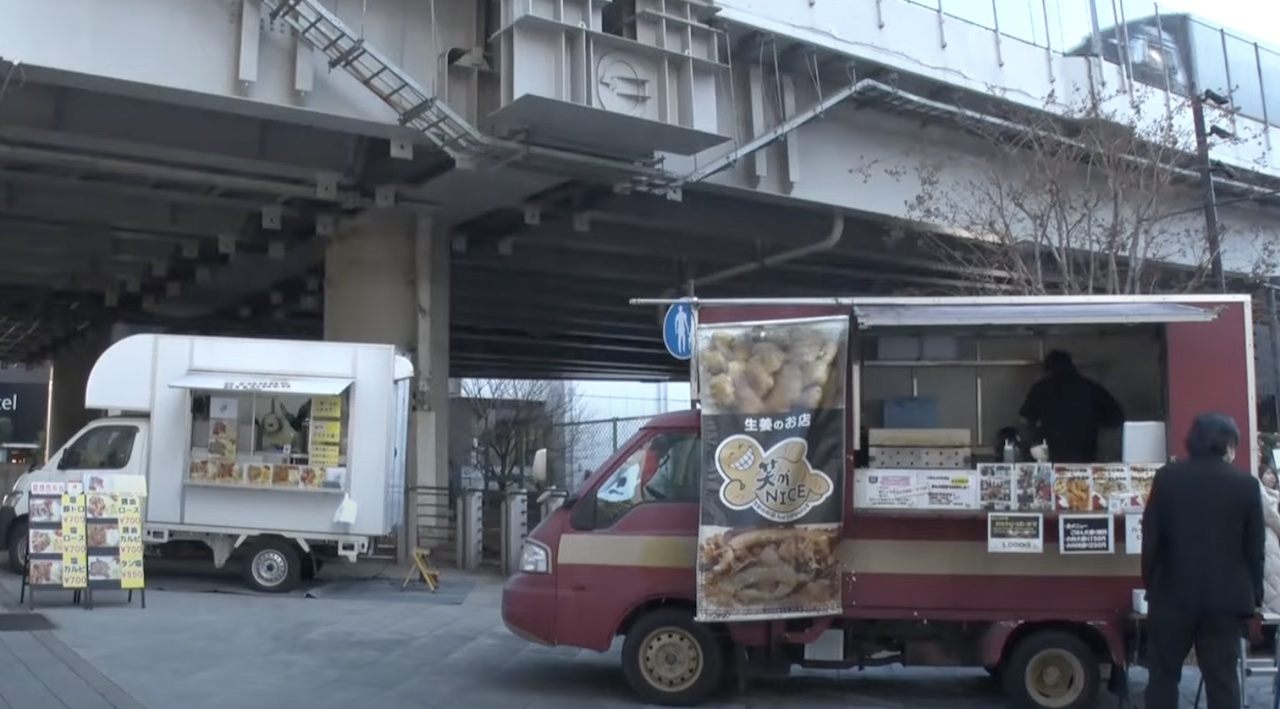
At Otemachi Kawabata Food Garden in Chiyoda, Tokyo, about 10 kitchen cars rotate daily, offering a variety of international cuisines. The kebab kitchen car, in particular, had a long queue.

Customers express their willingness to wait in line for their favorite chicken kebab, priced reasonably at 750 yen.

A Taiwanese food truck offers authentic flavors of 'Lu Rou Fan' at 800 yen, and the New York staple 'Chicken Over Rice' is available at 880 yen, featuring spiced chicken and tangy sauce over turmeric rice.

Gourmet Pizza Battles

Mellow, which introduces kitchen car locations, reports a fourfold increase in registrations since the pandemic.

Mellow's CEO Masayoshi Ishizawa notes, "The low startup cost has attracted many new entrants. To be chosen by customers, it's not just about taste, but also service quality."

As the number increases, only those offering restaurant-quality dishes can survive.

Among them, a transformed truck parked in front of an office building in Tokyo is worth further investigation. Offering gourmet pizza, this kitchen car has gone to the next level.

TJK PIZZA's owner, Mr. Light Elbe (54), a French national, installed a top-of-the-line Italian pizza oven inside the truck. This 850,000 yen oven enables him to bake authentic pizzas.

Elbe says, "Quality is key. Customers won't be satisfied with price alone."

The Challenge of a Sushi Kitchen Car

An unusual kitchen car targeting sushi-lovers has social media tongues melting. The young owner, 25-year-old Sakai Kobayashi, from a fishing town in Shizuoka, sought to use his family's wasabi in his venture.

As a cost-cutting measure, his mother, Takara, helped him modify the kitchen car. Even though she worries for her son, she supports his ambition.

After training in a famous sushi restaurant in Tokyo, Kobayashi decided to use his family's wasabi to promote their business.

On the opening day, he rushed to Toyosu Market for fresh ingredients. But he was late due to the preparation time.

His first order was a 1,500 yen 'Bara Chirashi,' followed by more customers, but the service was slower than expected. The day ended with just five customers and 15,000 yen in sales.

Kobayashi realized the need to streamline his operation. Despite a tough start, his journey with the family-dream kitchen car had just begun.

Source: ANN
Revolutionizing Street Food: The Rise of Gourmet Kitchen Cars in Japan
News On Japan
POPULAR NEWS

A tropical depression near the Mariana Islands was moving north-northwest at about 15 kilometers per hour as of 3 a.m. on September 16 and is expected to develop into a typhoon later in the day before potentially approaching the Pacific coast of eastern and western Japan with a storm-force wind zone during the latter half of the Silver Week holiday.

A new top-tier "Supreme Class" offering fully private compartments above the level of Green Car service will debut on the Tokaido and Sanyo Shinkansen on October 1, with passengers able to experience the new seating at a demonstration booth at Shin-Osaka Station.

A Japan Air Self-Defense Force Global Hawk unmanned reconnaissance aircraft went missing over international waters about 50 kilometers north of Tottori Prefecture on September 15, with floating debris and oil later found in the area where communications were lost.

GO, Waymo and Nihon Kotsu said they aim to launch Japan's first commercial fully driverless taxi service in Tokyo during 2027, using Level 4 autonomous vehicles that can operate without a driver on board under specified conditions.

Kajima Corp. has unveiled the construction site of KAJIMA TREE, a roughly 60-meter wooden tower being built for the International Horticultural Expo that will open in March 2027.

MEDIA CHANNELS
         

MORE Food NEWS

Authorities are warning people not to rely on artificial intelligence, guidebooks or internet searches to decide whether wild mushrooms are safe to eat after food poisoning cases involving toxic species, including one in which AI mistakenly identified a poisonous mushroom as edible.

Tokyo's Fuchu Prison is adapting its meals and living arrangements to a growing foreign inmate population, with about one in four prisoners coming from overseas and staff balancing religious, cultural and dietary needs against tight budgets and the demands of running one of Japan's largest prisons.

The cost of making a serving of curry rice at home in Japan fell below 350 yen in July for the first time in 11 months, helped by declining rice prices, according to Teikoku Databank.

Grape-picking season has reached its peak at tourist farms in Kashiwara, Osaka Prefecture, where hot weather from spring through summer has produced particularly sweet, richly flavored fruit this year, although prolonged rain has reduced visitor numbers and could shorten the season.

The autumn red snow crab season has opened on the Sea of Japan coast, with the first auction at Kasumi Fishing Port in Kami, Hyogo Prefecture, recording a top price of 300,000 yen for a single crab on September 4.

Japan's Environment Ministry will conduct its first survey of animal cafes, where customers can interact with animals including exotic species, as concerns grow over infection risks, injuries and the welfare burden placed on animals.

Japan byFood and Shizuka are back with Worth The Trip the series where we will discover food spots in Japan that are actually worth traveling for! This time we are going to award-winning eats around Tokyo under one rule – we can only eat for $10 or around ¥1,600 yen.

Japan's 2026 rice harvest is expected to show mixed results across the country, with yields slightly above the previous year's level in five prefectures, roughly unchanged in 20 and slightly lower in 21, according to an Agriculture Ministry forecast released on August 31.