News On Japan

What You Thought You Knew About Bacon and Ham Might Be Wrong!

What You Thought You Knew About Bacon and Ham Might Be Wrong!

TOKYO - It seems that bacon and ham, staples in our diet, are quite similar, but what actually differentiates them?

Bacon and Ham: A Common Misconception?

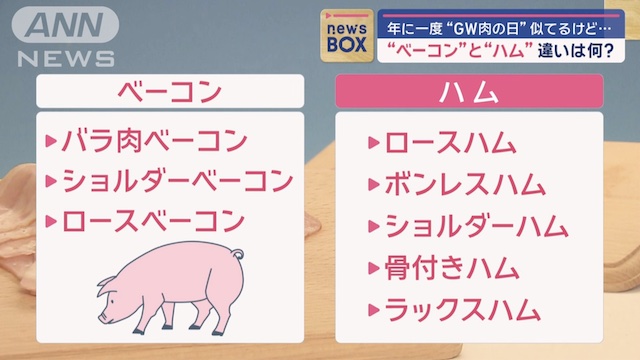
During the "Meat Day (29th)" celebrations, which coincided with Golden Week, various meat festivals were held across the country. We all know about bacon and ham, but what exactly is the difference between these two meats? It might surprise you what people think:

A person in their 60s said, "I always thought bacon came from the belly of the pig (and ham from loins or thighs)."

A person in their 20s mentioned, "Isn't it whether you can eat them raw? Ham is generally eaten raw, and bacon is intended to be cooked."

Another in their 30s noted, "They come from different types of meat."

And yet another in their 20s pondered, "Maybe they come from different animals?"

Is it the part of the pig they come from, or the way they are processed? What really is the difference?

Manufacturing Process: More Similar Than You Think

Masayuki Nagata, the marketing director at Nippon Ham who has been involved in bacon and ham development for over 20 years and consumes them daily, provided some insights.

Nagata said, "Many customers ask if it's the type of meat used, but actually, that’s not the case."

Contrary to popular belief, where bacon is generally thought to be made from pork belly and ham from the loin, there are many types available. There are bacons made from loin and hams made from belly meat.

So, what really distinguishes bacon from ham?

Nagata clarified, "The clear difference lies in the method of heat processing. Think of roast ham, which is typically steamed or boiled, versus bacon, which is cured through smoking. This is where the processes diverge."

In essence, bacon and ham start with almost identical manufacturing steps, but it is the cooking process that differentiates them. Bacon is solely smoked, whereas ham is primarily boiled or steamed.

There are some types of ham that are smoked, but if it's only smoked, it's bacon; if it’s prepared through other heat methods, it's considered ham.

Furthermore, it’s important to note that prosciutto, known as raw ham, is categorized differently since it's uncooked meat, unlike bacon and ham, which are cooked meats.

A person in their 40s commented, "I never knew this. It’s quite interesting."

And someone in their 30s added, "I think I'll discuss this with my family when I get home."

Source: ANN

News On Japan
POPULAR NEWS

Typhoon No. 26 was passing through the southern Izu Islands on October 1, disrupting ferry and air services around Hachijojima even as authorities reported no confirmed damage, while a newly formed Typhoon No. 27 was forecast to strengthen and potentially affect the Ogasawara Islands next week.

Tokyo authorities carried out the capital's first emergency shooting of a captured bear in Hachioji after an adult Asiatic black bear was found caught in a trap near a residential area about 8 kilometers from Takao Station.

Japan's total population, including foreign residents, stood at 122.97 million as of October 1, 2025, down 3.17 million from the previous census in 2020, marking only the third decline since the national census began in 1920.

A woman in her 50s with severe heart failure underwent what was described as the world's first surgery using commercially available iPS cell-derived heart muscle sheets at an Osaka hospital on September 29, marking the first practical use of the regenerative treatment.

Tokyo recorded rain for a 34th consecutive day on September 29, setting a new all-time record for the capital, but the prolonged wet spell could finally end after Typhoon No. 26 passes the Izu Islands between the night of September 30 and the morning of October 1.

MEDIA CHANNELS
         

MORE Food NEWS

Prices of leafy vegetables are rising sharply across Japan as prolonged rainfall and reduced sunlight in September damage crops and disrupt harvesting, with farmers warning that shortages could continue into winter and push prices even higher during the peak season for hot pot dishes.

Prolonged rainfall in Tokyo lasting more than 20 days, combined with heavy rain from Typhoon No. 25 during the Silver Week holidays, has disrupted vegetable supplies and driven up prices, with some retailers facing the possibility of suspending sales of popular seasonal products such as roasted sweet potatoes.

Nara Prefecture is home to a remarkable variety of traditional dishes, including an ancient cheese-like food dating back some 1,300 years, a wild mountain vegetable enjoyed for generations and a homemade crepe once served on special occasions, offering a glimpse into the region's long culinary history.

Families and visitors are flocking to a farm in Minoh, Osaka Prefecture, to enjoy autumn chestnut picking, with this year's harvest producing smaller but particularly sweet chestnuts due to a lack of rainfall.

For more than six decades, Sanyuken Fukasawa Branch in Tokyo's Setagaya Ward has served generations of customers with familiar Chinese dishes, as its 72-year-old second-generation owner and his wife continue to run the 14-seat neighborhood restaurant largely by themselves.

Authorities are warning people not to rely on artificial intelligence, guidebooks or internet searches to decide whether wild mushrooms are safe to eat after food poisoning cases involving toxic species, including one in which AI mistakenly identified a poisonous mushroom as edible.

Tokyo's Fuchu Prison is adapting its meals and living arrangements to a growing foreign inmate population, with about one in four prisoners coming from overseas and staff balancing religious, cultural and dietary needs against tight budgets and the demands of running one of Japan's largest prisons.

The cost of making a serving of curry rice at home in Japan fell below 350 yen in July for the first time in 11 months, helped by declining rice prices, according to Teikoku Databank.