News On Japan

Luxury Dining Train Returns for the First Time in 100 Years

OSAKA - Nankai Electric Railway will begin operating a new sightseeing train connecting Namba and Koyasan on April 24th, with the full details unveiled to the media on April 9th.

The new train, named "GRAN Tenku," was revealed at the newly established Platform 0 at Namba Station, featuring a deep crimson exterior and offering a roughly 90-minute journey to Gokurakubashi, the gateway to Koyasan, as Buddhist monks from Koyasan performed a prayer ceremony for its safe operation.

Nankai Electric Railway President Tomoshi Kajitani said, "We aim to transform the journey to Koyasan from a mere means of transportation into an experience where the travel itself becomes the purpose, with heartfelt hospitality at its core."

The four-car train will operate with all reserved seating, with Car 1 featuring spacious relaxation seats, Car 2 offering wide-view seats facing the windows, and Car 3 serving as a lobby lounge selling beverages, while Car 4 provides a more exclusive experience.

Reporter Sasuke Yamaguchi said, "The sofa seats, limited to just 16 passengers, are exceptionally comfortable, and remarkably, passengers can also enjoy meals."

Passengers seated in the sofa section will be served breakfast, afternoon tea, and other offerings depending on the time of day, featuring locally sourced ingredients from southern Osaka to Wakayama, marking the first time in nearly a century that Nankai Electric Railway has provided meals onboard.

Dining cars were once popular during the Meiji and Taisho eras more than 120 years ago, but were discontinued in 1929 as the need to increase transport capacity grew, with onboard dining seen as limiting both speed and passenger numbers.

The revival of the dining car after nearly 100 years reflects a broader effort to position train travel itself as a destination rather than simply a mode of transport.

Kajitani said, "We hope passengers will enjoy both the scenery along the route to Koyasan and the meals, allowing them to fully experience the appeal of railway travel."

The 90-minute journey linking Osaka and Wakayama is being reimagined as a premium travel experience, as private railway operators across the Kansai region intensify competition to develop new services.

Source: YOMIURI

News On Japan
POPULAR NEWS

Japan’s World Cup campaign ended in the cruelest possible fashion on June 29, as Gabriel Martinelli scored in the fifth minute of stoppage time to give Brazil a 2-1 victory over the Samurai Blue in their knockout match in Houston. Japan had led in the first half and were still level at 1-1 in the final moments, but Martinelli’s late strike sent Brazil into the Round of 16 and eliminated Japan from the tournament.

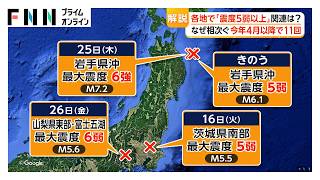
Strong earthquakes have continued to shake parts of Japan in recent weeks, with 11 temblors measuring lower 5 or above on the Japanese seismic intensity scale recorded across the country since April 2026.

A Kintetsu Railway train derailed inside Kyoto Station on the morning of June 29, forcing partial suspensions on the Kintetsu Kyoto Line for the rest of the day and causing long delays that hit commuters, students and tourists.

A section of stone wall at Hikone Castle, one of Japan’s few surviving original Edo-period castles and a National Treasure whose main keep remains intact more than 400 years after its construction, collapsed after heavy rain caused by Typhoons No. 7 and No. 8, Hikone city officials said.

Japan advanced to the knockout stage of the World Cup after a 1-1 draw with Sweden on June 25, finishing second in Group F and setting up a Round of 32 clash with Brazil in Houston.

MEDIA CHANNELS
         

MORE Travel NEWS

A section of stone wall at Hikone Castle, one of Japan’s few surviving original Edo-period castles and a National Treasure whose main keep remains intact more than 400 years after its construction, collapsed after heavy rain caused by Typhoons No. 7 and No. 8, Hikone city officials said.

The Japan Meteorological Agency said at around 2 p.m. on June 29 that the rainy season appeared to have ended in Okinawa, marking a later-than-usual start to summer after an especially wet period.

Japan’s weather agency carried out field inspections in Yamanashi Prefecture on June 28 after a powerful earthquake struck the Fuji Five Lakes area late on June 26, registering a lower 6 on Japan’s seismic intensity scale in Fujikawaguchiko and injuring six people.

According to updates on June 28, the double-typhoon system that brought record rain, flooding, landslides and fallen trees to parts of Japan has moved away, but Kanto remains under cloudy rainy-season skies, with intermittent rain still possible and saturated ground keeping the risk of landslides high in areas hit by heavy rain.

The Kanto region is experiencing an unusual June, with three typhoons approaching the area during the month and rainfall totals already reaching record levels in some locations.

Damage was reported across the Kansai region after a stationary seasonal rain front and an approaching typhoon brought torrential rain on June 26, triggering landslides in Seika, Kyoto Prefecture, flooding homes in Nara, and disrupting roads and railway services in Osaka and surrounding areas.

A powerful earthquake with a maximum seismic intensity of upper 6 struck off Iwate Prefecture at around 7:30 a.m. on June 25, shaking parts of Aomori Prefecture and leaving Hachinohe, which was hit by a similarly strong quake last December, facing fresh damage.

Rice field art depicting Los Angeles Dodgers star Shohei Ohtani and his dog Decoy is nearing its best viewing period in Oshu, Iwate Prefecture, Ohtani’s hometown.