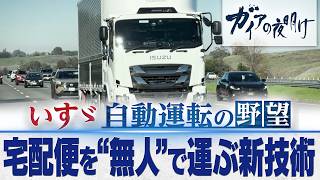


TOKYO - Isuzu Motors has begun full-scale development of a second-generation "AI truck" capable of making driving decisions on its own, as Japan's largest commercial vehicle maker by domestic market share aims to introduce Level 4 autonomous driving in fiscal 2027 to help address a worsening shortage of truck drivers.
Japan is projected to face a serious logistics crisis by 2030, when driver shortages could leave the country unable to transport as much as 25% of its current freight volume.
The consequences could affect everyday life, with supermarkets and convenience stores unable to keep shelves fully stocked and online purchases failing to arrive on schedule.
Isuzu sees autonomous driving as one way to maintain Japan's freight network as the labor shortage deepens.
The company is targeting the social implementation of Level 4 autonomous driving, in which vehicles can operate without a driver under specified conditions, during fiscal 2027.
Autonomous vehicles have become a major global growth market, drawing intense competition from technology companies including Google, Amazon and Nvidia. Japan is also seeking to strengthen its position through cooperation between the government and private sector.
At the CES technology exhibition in Las Vegas in January, autonomous driving was among the technologies attracting attention.
Nvidia introduced Alpamayo, an artificial intelligence system for autonomous driving that can assess surrounding conditions and make decisions independently.
The company said the technology could significantly improve the safety of driverless vehicles.
Some estimates put the global autonomous driving market at about 18 trillion yen within the next three years.
Isuzu representatives were among the Japanese visitors studying the latest technology at CES as the truckmaker seeks to narrow the gap with overseas competitors.
One Isuzu employee involved in the effort said the company is still learning about advanced AI technology and gathering information from specialists around the world as it tries to understand how leading developers are approaching autonomous driving.
The United States has moved ahead of Japan in the field, with commercial operations involving driverless trucks beginning in spring 2025 and gradually expanding.
Japan, by comparison, reached the stage of joint autonomous driving trials by four major commercial vehicle manufacturers in 2025, while the government has begun stepping up support for development.
Isuzu is conducting repeated tests using a heavy-duty truck with the ultimate goal of fully driverless operation on expressways.
During testing, the truck demonstrated its ability to merge from an acceleration lane into moving traffic.
It allowed a vehicle traveling alongside it to pass before entering the main traffic lane safely.
In another test, the truck detected an obstacle ahead and changed lanes on its own.
The vehicle's ability to assess road conditions and make decisions independently has led developers to describe it as an AI truck.
Hiroshi Sato, who is leading Isuzu's autonomous driving development, said the company sees driver shortages and insufficient transport capacity as major social challenges.
He said automating some driving operations could help make logistics more efficient and compensate for the shrinking number of drivers.
"Maintaining and securing logistics is necessary not only for our own lives, but also for Japan as a country to continue functioning properly," Sato said. "We feel that if we don't act now, there will be serious problems, so we are moving quickly."
Developing a vehicle capable of operating without a driver, however, presents major technological and safety challenges.
Isuzu has turned to expertise in Silicon Valley in the United States as part of its development effort, placing safety at the center of the project.
Real-world roads are filled with situations that are difficult to predict, including rare events that autonomous systems may have little experience handling.
Developers say one of the biggest challenges is collecting enough examples of unusual situations and teaching the system how to respond appropriately.
Ensuring safety without a human driver remains one of the central hurdles as Isuzu works toward practical deployment during fiscal 2027.
The project is also taking place against intensifying international competition in autonomous vehicle technology.
Isuzu traces its roots to 1916 and later succeeded in domestically producing trucks, becoming one of the companies that supported the development of Japan's logistics industry.
The company expanded more seriously into passenger vehicles from the late 1950s, later producing models including the compact Gemini and the Piazza, which was designed with the involvement of an Italian designer.
After excessive investment contributed to financial difficulties in the 1990s, Isuzu was eventually forced to withdraw from the passenger car business.
It has since concentrated on commercial vehicles.
Today, Isuzu produces vehicles including the Elf light-duty truck and the Giga heavy-duty truck, centered on its Fujisawa plant in Kanagawa Prefecture.
The group has annual sales of more than 3 trillion yen and employs more than 40,000 people across 21 countries.
Having spent decades supplying the trucks that underpin Japan's distribution system, Isuzu is now betting that autonomous driving can help it continue that role as the industry confronts one of its most serious labor shortages.
Source: テレ東BIZ