
News On Japan

Ax Falls on Japan’s Iconic Moped

TOKYO, Oct 14 (News On Japan) - Production of Japan’s familiar 50cc motorized bicycles — a popular choice for short trips and errands — will come to an end in October, prompting a surge in demand as consumers scramble to purchase the last available models.

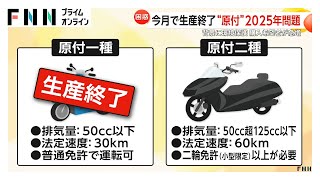
Under Japan’s classification system, mopeds are divided into two categories: Class 1, with an engine displacement of 50cc or less and a legal speed limit of 30 km/h, and Class 2, with a displacement over 50cc but under 125cc and a speed limit of 60 km/h. It is the Class 1 mopeds — which can be ridden with an ordinary driver’s license — that all domestic manufacturers will stop producing this month.

Dealers say demand has risen sharply ahead of the deadline. “A month ago, a customer came all the way from Kobe asking us to sell one because there were none left locally. He was even willing to pay for shipping,” said Yukio Shinbo, manager of B-Power’s Adachi store. The main reason for the production halt is new emissions regulations taking effect in November. “The standards for environmental and safety rules have become extremely strict,” Shinbo explained. “If we try to build a 50cc engine that meets those requirements, production costs soar, and scooters would end up priced at 400,000 to 500,000 yen. At that point, who would buy them?”

During interviews, one customer who came to the store decided to buy within two minutes of entering. “Since 50cc bikes are disappearing, I wanted to get one while I still can,” he said. Others who rely on mopeds for work are more anxious. “I’m worried maintenance costs will rise once parts become unavailable,” said a food delivery worker for Uber Eats.

Newspaper delivery services are also bracing for the impact. “We’re in real trouble,” said Tomihiro Tagami, head of the Narimasu Akatsuka Hikarigaoka branch of Sankei Shimbun. “Our first option is to switch to electric bikes, and the second is to have all employees obtain a medium motorcycle license and switch to larger models. But electric bikes are expensive, so converting the entire fleet now is difficult.”

Under the revised regulations, ordinary license holders will still be able to ride motorcycles up to 125cc if their maximum output is limited to 4 kW. Pizzala, a major pizza delivery chain, said it is considering introducing electric bikes, stating, “We will monitor developments closely and seek the most suitable vehicle mix, taking safety and operational costs into account.”

The shift is expected to affect not just delivery services but also ordinary consumers. How the landscape for small motorbikes evolves in the coming years remains to be seen.

Source: FNN

News On Japan
POPULAR NEWS

The Niseko area at the foot of Mount Yotei, about a two-hour drive from Sapporo, is now in the spotlight once again as one of Japan’s top resort destinations prepares for the peak ski season. Fueled by surging inbound demand, construction of hotels and leisure facilities is rapidly expanding across the region—but local residents are increasingly alarmed by the rise in illegal land development and unauthorized building extensions.

The Budget Committee of the House of Representatives opened on November 7th, with Prime Minister Takaichi facing her first full-scale debate since taking office.

A power outage that halted operations on the Sapporo Municipal Subway on November 3rd was caused by an aluminum-coated balloon. Investigations have revealed that similar troubles have occurred across various transportation systems in Japan.

The National Police Agency announced on November 6th that it has revised the National Public Safety Commission regulations to allow police officers to use rifles for bear control. The amendment will take effect on November 13th.

In the House of Councillors on November 6th, Prime Minister Takaichi faced her first major challenge from Sanseito leader Sohei Kamiya, who took the podium for the first time to question the government’s stance on accepting foreign workers.

MEDIA CHANNELS
         

MORE Business NEWS

Gasoline prices rose for the first time in four weeks to 173.60 yen per liter as of 2 p.m. on November 6th, up just 0.10 yen from the previous week. However, with the government’s decision on November 5th to abolish the provisional gasoline tax by the end of the year, prices are expected to fall in stages before the abolition takes full effect.

Nissan Motor announced on November 6th that it will sell its Yokohama headquarters building for 97 billion yen as part of a broader restructuring plan, while continuing to occupy the property under a lease agreement.

Around 1,200 investors have filed a class-action lawsuit with the Osaka District Court seeking the return of more than 11.4 billion yen from the real estate fund “Minna de Ooya-san,” which has been delaying distribution payments to its investors.

Real wages in Japan fell 1.4% in September from a year earlier, marking the ninth consecutive month of decline, as rising prices continued to outpace wage increases, according to data released by the Ministry of Health, Labour and Welfare.

The economic policy bannered by Prime Minister Takaichi as “Sanaenomics” is beginning to take shape, with expectations centering on lower gasoline prices and the restart of electricity and gas subsidies even as critics say the program’s substance remains unclear and insufficiently developed.

Japan’s space industry is gaining new momentum under Prime Minister Takaichi’s vision of building a “strong economy,” with the sector identified as a key target for strategic investment alongside AI and energy security.

Nintendo has raised its forecast for the upcoming fiscal year ending in March 2026, projecting revenue to exceed 2 trillion yen for the first time.

Farmers across western Japan are facing mounting losses from the growing population of nutria, large semi-aquatic rodents originally brought from South America. Once imported for their fur, the animals have become a major agricultural pest, chewing through crops and spreading rapidly into urban areas.