
News On Japan

Bears May Know When Astringent Persimmons Become Sweet

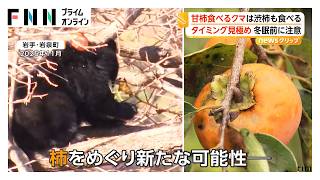
HYOGO - Bears preparing for winter hibernation may be able to determine when astringent persimmons have lost their bitterness and become suitable to eat, according to research by the University of Hyogo, which suggests that prioritizing the removal of sweet persimmon trees could help prevent bears from entering residential areas.

As bear activity increases ahead of hibernation, persimmon trees have been identified as one of the factors attracting the animals into populated areas, raising concerns about encounters with humans.

A University of Hyogo study found that bears began eating sweet persimmons as early as late July, while they generally avoided astringent varieties until late November or later.

The difference in feeding behavior suggests that bears may be sensitive to changes in the fruit's chemical composition, allowing them to recognize when its bitter taste has diminished.

Daisuke Fujiki, an associate professor at the University of Hyogo, said the findings indicate that bears use the concentration of astringent compounds in persimmons to determine whether the fruit is suitable for consumption.

"We found that whether the concentration of astringent compounds falls below a certain level appears to be a factor in determining whether bears will eat the fruit," Fujiki said.

The findings suggest that bears may be capable of identifying the point at which astringent persimmons become palatable, rather than simply consuming whatever fruit is available.

Researchers warn that astringent persimmons could increasingly attract bears as their bitterness naturally declines in the coming weeks, particularly during the period leading up to winter hibernation.

However, because sweet persimmons attract bears much earlier in the season, researchers believe that prioritizing the removal of sweet persimmon trees in areas vulnerable to bear encounters could be an effective preventive measure.

The study highlights the importance of managing fruit trees around residential communities, particularly during autumn when bears are actively searching for food before entering hibernation.

Source: FNN


On a light note, here is the pilot of a fictional story about a mystical village in Japan where bears and humans live in harmony.

News On Japan
POPULAR NEWS

Japan launched a new national disaster management agency on November 2nd to strengthen its response to major emergencies, just days before a powerful earthquake struck Aichi Prefecture, injuring 24 people and renewing concerns over the possibility of a catastrophic Nankai Trough earthquake.

Russia's Foreign Ministry on November 11 defended the government's unilateral decision to place the local subsidiary of Japan Tobacco (JT) under the management of a Russian company, describing the move as a countermeasure against what it called Japan's "blatantly hostile actions."

East Japan Railway (JR East) announced on November 10th that it will introduce touch-free ticket gates at 40 stations, including every station on Tokyo's Yamanote Line, from spring 2028, allowing passengers using Mobile Suica to pass through without taking their smartphones out of their pockets or bags.

Japan's Children and Families Agency unveiled its first national guidelines on November 10th for parental involvement in children's internet use, dividing those aged 0 to 18 into six developmental stages as the government considers tighter regulations on social media platforms to protect young people from online bullying, exploitation, and other growing risks.

As of 3 a.m. on Wednesday, November 11, Typhoon No. 32 was moving east-northeast over waters east of Chichijima in the Ogasawara Islands, gradually heading away from the Japanese archipelago after passing near the island between late Tuesday night and early Wednesday morning.

MEDIA CHANNELS
         

MORE Food NEWS

Japanese researchers are developing a new generation of nursing care meals using 3D printing and other advanced food technologies, creating realistic-looking sushi, vegetables and other dishes that can be safely enjoyed by elderly patients and people who have difficulty chewing or swallowing.

Kyoto's Shin-Kyogoku Shopping Street, a bustling 500-meter arcade with more than 150 years of history, is home to some of the city's oldest restaurants, seven Buddhist temples and a Shinto shrine, while a recently rediscovered 90-year-old restaurant manual has revealed unusual dishes and the philosophy of a pioneering Western-style restaurant.

Osaka's iconic Midosuji boulevard hosted its first-ever bread-eating race on November 6 as part of a three-day event exploring new ways to use public space, with 1,200 servings of sweet bean buns and dorayaki pancakes prepared for participants over two days as the city moves ahead with plans to transform the major thoroughfare into a more pedestrian-friendly destination by 2037.

Bears preparing for winter hibernation may be able to determine when astringent persimmons have lost their bitterness and become suitable to eat, according to research by the University of Hyogo, which suggests that prioritizing the removal of sweet persimmon trees could help prevent bears from entering residential areas.

FamilyMart will introduce its first do-it-yourself Christmas cake for the 2026 holiday season, allowing customers to decorate their own cakes as the convenience store chain seeks to attract demand for affordable, at-home celebrations.

Japan by Food and Shizuka head into the mountains of Nagano to explore Karuizawa, a historic highland resort just over an hour northwest of Tokyo, to see if it’s truly Worth The Trip. Join Shizuka as she strolls the iconic street food and rolls up her sleeves to make Nagano soba from scratch! (Japan by Food)

Bean sprouts, long regarded as one of Japan's most affordable and dependable vegetables, are becoming increasingly expensive as rising raw material costs and soaring energy bills push up production expenses, putting pressure on ramen shops and hot pot restaurants that rely heavily on the ingredient.

Hokuyo Bank has launched an agricultural initiative in Hokkaido aimed at addressing a growing shortage of farmers and agricultural workers, with bank employees taking to the fields themselves to gain practical experience and help aspiring farmers and businesses enter the industry through financial assistance, technical training, and hands-on guidance.