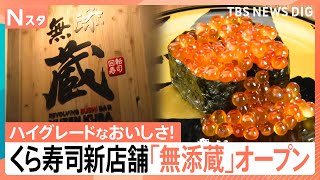
TOKYO - Kura Sushi has opened its second premium conveyor-belt sushi restaurant in Tokyo, introducing a menu of higher-grade seafood and same-day deliveries from Hokkaido by bullet train as the company seeks to stand out in Shinjuku’s fiercely competitive dining market.
The new Muten Kura restaurant opened last week on the sixth floor of a large building about a one-minute walk from Shinjuku Station. With 193 seats, it is the largest location operated under the premium brand.
The restaurant combines the convenience and affordability of conveyor-belt sushi with elaborate preparation, carefully selected ingredients and a more luxurious dining environment.
Among the main offerings is a three-piece assortment of domestically sourced Pacific bluefin tuna featuring lean tuna, medium-fatty tuna and fatty tuna for 980 yen. Thick slices of organic yellowtail, served two pieces for 400 yen, are scored with decorative knife cuts and brushed with soy sauce before being served.
A generous serving of premium sea urchin costs 630 yen for two pieces, while freshly harvested Hakodate salmon from Hokkaido is offered at 420 yen for two pieces. Customers praised the salmon’s firm, springy texture and rich flavor.
The restaurant’s interior uses indirect lighting and partitions around every table to create a semiprivate setting where customers can dine at a more relaxed pace. More floor staff are assigned than at a standard Kura Sushi restaurant, and employees kneel beside tables when responding to customers.
Muten Kura is a special format operated at only six of Kura Sushi’s 557 restaurants in Japan. The brand began expanding in the Kansai region in 2005 and opened its first Kanto location in Tokyo’s Nakameguro district in 2025.
The company selected Shinjuku for its latest and largest restaurant despite intense competition. About 100 sushi restaurants operate within a 500-meter radius of Shinjuku Station.
One of the new restaurant’s main attractions is a same-day delivery program known as Shinkansen Fish, in which seafood is dispatched by bullet train shortly after being harvested and prepared. Kura Sushi describes the system as an industry-first initiative.
The company previously transported seafood directly from Fukui Prefecture to its Nakameguro restaurant, where the products proved popular. For the Shinjuku opening, it set out to deliver fish from Hakodate, about 800 kilometers away.
The project was led by veteran seafood buyer Takao Ohama, who spends more than half the year visiting ports and fishing communities in search of new products.
Ohama focused on Hakodate salmon, a developing regional brand raised in the cold waters off northern Japan. The fish is known for high-quality fat and a rich flavor.
Immediately after being killed and prepared, the salmon retains a particularly firm and crunchy texture known in the industry as ikarimi. That quality gradually fades over time, making rapid transportation essential.
Kura Sushi’s plan was to carry the salmon alive from the port to a processing facility about 50 kilometers away, keep it alive until shortly before departure and then place it on a Shinkansen train immediately after processing.
During an initial test one month before the restaurant opened, salmon were placed in a specialized tank that maintained appropriate water temperature and oxygen levels. After the roughly one-hour journey to the processing plant, however, the fish appeared considerably weakened.
The team concluded that the salmon had become startled by the darkness inside the tank, causing them to thrash around and strike their heads. Ohama pledged to repeat the test until the problem was resolved, saying the restaurant could not offer the distinctive firm texture unless the transport system worked.
Preparations inside the Shinjuku restaurant also presented difficulties. Two weeks before opening, about 130 employees were undergoing intensive training under the direction of a manager with 25 years of experience in restaurant operations.
The scale of the restaurant and the detailed preparation required for its premium menu created unfamiliar challenges. Unlike standard conveyor-belt sushi, many dishes require decorative knife work, hand-rolled ingredients and precise presentation.
One signature dish, priced at 1,000 yen, features alternating layers of medium-fatty and fatty Pacific bluefin tuna wrapped in Ariake seaweed in a mille-feuille-style roll. During training, loosely rolled seaweed left visible gaps, forcing staff to remake the dish.
Managers also checked minute details such as the angle of sliced omelet, the visibility of rice beneath seafood toppings and the positioning of garnishes. Even slight tilting or exposed rice was considered unacceptable.
Four days before opening, employees conducted a full simulation in which staff members acted as customers. Orders quickly accumulated in the kitchen, warning indicators showed delayed dishes and time-limit alarms continued to sound.
A particularly difficult item was a Shinjuku-exclusive seafood platter containing seven varieties of seafood arranged on a 70-centimeter plate for 2,780 yen. Staff struggled to balance the arrangement, leading to repeated corrections and delays.
The practice session ended with managers acknowledging that orders had been served too slowly and that the kitchen had become overwhelmed. Employees were left with four days to improve.
On opening day, the restaurant set a minimum target of 500 customers. Business was initially quiet when the doors opened at 11:30 a.m., but all 193 seats were soon occupied and orders began pouring into the kitchen.
Employees who had struggled with the layered tuna roll during training produced it cleanly after repeated daily practice. The large seafood platter was also completed successfully, drawing customers who photographed the dish before eating.
One family visited to celebrate a son’s 26th birthday, reflecting the restaurant’s effort to position itself as an affordable venue for special occasions.
By the end of the lunch peak, however, customer numbers had not yet reached half of the daily target. Attention then turned to the expected arrival of seafood from Hakodate.
At 4 a.m. that day, Hakodate salmon were still swimming actively in the processing facility’s holding tank. The transport tank had been improved with lighting to prevent the fish from panicking during the 50-kilometer journey.
After arriving safely at the facility, the salmon were processed in the morning and placed aboard a 7:30 a.m. Shinkansen bound for Tokyo. The shipment reached Shinjuku at around 3 p.m., and the fish were served to customers by about 3:30 p.m., roughly 800 kilometers from where they had been alive that morning.
Customers praised the salmon’s elasticity and flavor, with some ordering additional servings.
Other same-day seafood from Hokkaido included raw kurosoi rockfish, which has a soft, chewy texture and refined flavor when freshly prepared, and yanaginomai rockfish, a sweet white fish that deteriorates quickly and is rarely distributed outside its local region. Both were priced at 420 yen for two pieces.
Ohama said he was relieved that the products had reached customers as planned. For seafood buyers, he said, hearing customers describe the fish as delicious was the highest praise.
One customer said the meal felt special, while another described the restaurant as offering a level of luxury that remained affordable enough to share with family.
The Shinjuku restaurant ultimately surpassed its opening-day target of 500 customers. Its manager said the team would continue working to provide an even higher level of satisfaction from the following day.
Source: TBS