News On Japan

World’s First Fully Farmed Eels to Go on Sale in Japan

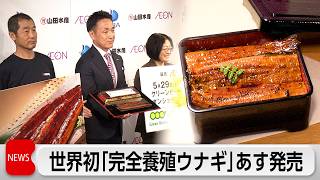
TOKYO - Japan will begin trial sales of the world’s first fully farmed eels for consumers on May 29th, marking a major milestone for the aquaculture industry as domestic eel prices have already fallen by about 40% from a year earlier.

The so-called "fully farmed eel" refers to eels raised entirely by human intervention from egg to adulthood, unlike conventional farmed eel production, which relies on capturing wild juvenile glass eels known as "shirasu unagi" before raising them in captivity.

The trial sales, priced at 4,860 yen per eel, will begin at 10 a.m. on May 29th through Aeon Group’s online shopping platform and at locations including Nihombashi Mitsukoshi Main Store. Quantities are limited and sales will end once stock runs out.

Aeon and eel producer Yamada Suisan plan to conduct surveys on taste and pricing as they seek broader commercialization in the future.

The achievement comes after decades of research into eel breeding, an area long considered difficult because much of the eel’s life cycle remains poorly understood.

About 20 years ago, researchers were only able to raise between 10 and 100 eels annually. Before reaching the glass eel stage, larvae required feeding five times a day at two-hour intervals, while tanks had to be cleaned daily, pushing production costs per eel into the hundreds of thousands or even millions of yen.

Advances in feed development, automated feeding systems, and mass-production tank technology have since improved efficiency dramatically. Researchers can now raise around 10,000 eels annually, while production costs have reportedly fallen to about 1,800 yen per fish.

Industry observers say prices could decline further if mass production becomes viable.

Meanwhile, conventional eel prices have also been falling sharply due to strong catches of wild juvenile eels.

According to the Fisheries Agency, imported products accounted for about 73% of Japan’s eel supply in 2024, while more than 99% of processed eel products such as kabayaki were imported from China.

The wholesale price of processed Chinese eel products has fallen roughly 20% year-on-year, declining from 2,360 yen per kilogram in 2025 to 1,919 yen in 2026.

Shinya Matsuura, chairman of the Japan Eel Importers Association, said the decline was driven by the largest glass eel catch in 19 years last year, with those fish now reaching the market. Lower fuel and labor costs in countries such as China have also helped reduce prices.

Domestic eel prices have dropped even more sharply, falling about 40% from the same period last year.

Wholesale prices for domestic eel fell from 5,307 yen in April 2025 to 2,983 yen in April 2026.

Kengo Matsumoto, representative of eel wholesaler Unagi Donya Matsumoto, said bumper catches of glass eels over two consecutive years beginning in December 2024 had increased supply, driving wholesale prices down by 30% to 40%.

Matsumoto added that because summer is the peak sales season for eel restaurants, retail prices at restaurants may begin falling around September.

He also noted that if fully farmed eel production becomes widespread, the price of a domestically produced unaju meal could potentially fall from the current 4,000-yen range to around 2,000 yen, although existing eel farmers could face significant pressure as a result.

Source: TBS

News On Japan
POPULAR NEWS

As of 9 p.m. on May 30th, Typhoon No. 6 (Chanthu) was continuing to strengthen as it moved northwest over waters east of the Philippines, with Okinawa expected to face the worst conditions from June 1st to June 2nd as the storm passes nearby at strong intensity, while heavy rain is also forecast across western and eastern Japan, particularly along Pacific coastal regions.

A social media dispute between a 17-year-old high school student from Tokyo's Itabashi Ward and a 16-year-old boy from Edogawa Ward escalated into a planned group fight involving around 30 youths, some of whom allegedly brought weapons including a rusty saw, iron pipes, a special baton and even a shovel.

Japan's population stood at 123.05 million in 2025, according to preliminary results from the national census released by the Ministry of Internal Affairs and Communications, marking a decline of 3.097 million people over the past five years.

Volleyball player Shunichiro Sato, a member of Japan’s men’s national team, was arrested by the Tokyo Metropolitan Police Department on suspicion of possessing marijuana after allegedly leaving a bag containing the drug at a pachinko parlor in Tokyo.

The “naphtha shortage” triggered by escalating tensions in the Middle East is now spreading into Japan’s housing industry, with shortages of paint, thinner, insulation materials and other building products forcing construction delays across the country.

MEDIA CHANNELS
         

MORE Food NEWS

World-renowned musician YOSHIKI is betting on Hokkaido wine as Japan's next global export success story, joining a growing list of international figures and industry leaders who see the island as one of the world's most promising emerging wine regions.

I'll attempt to spend $100 on street food in Kyoto, Japan, but there's one problem: Japan is not really a street food country. Most people prefer to eat indoors, and finding street food is surprisingly difficult almost anywhere in the country—except in places like Nishiki Market. (More Best Ever Food Review Show)

Japan will begin trial sales of the world’s first fully farmed eels for consumers on May 29th, marking a major milestone for the aquaculture industry as domestic eel prices have already fallen by about 40% from a year earlier.

Curry udon, a dish combining the fragrance of spices with one of Kansai's most beloved noodle staples, has developed into a distinctly different style in Kyoto, where a thickened dashi-based curry broth created to withstand the city's harsh winters has become the defining feature of a local comfort food tradition.

Japan byFood featuring Shizuka are heading to a Dancing Crab Tokyo that's redefining the new normal table etiquette with NO plates, NO utensils, and definitely NO staying quiet! (Japan by Food)

Production of tencha, the raw material used to make matcha, has begun in Yamazoe, Nara Prefecture, a village known for producing Yamato tea, with around 20 tons expected to be manufactured by the end of July.

The video explores the colorful and immersive food experience at Japan’s Super Nintendo World, highlighting how the park combines Nintendo nostalgia with Japan’s high culinary standards. (More Best Ever Food Review Show)

Honeybees, long valued for producing honey, are now facing a growing survival crisis that experts warn could eventually threaten global food supplies, as climate change, rising temperatures, and spreading parasites continue to devastate bee populations around the world.